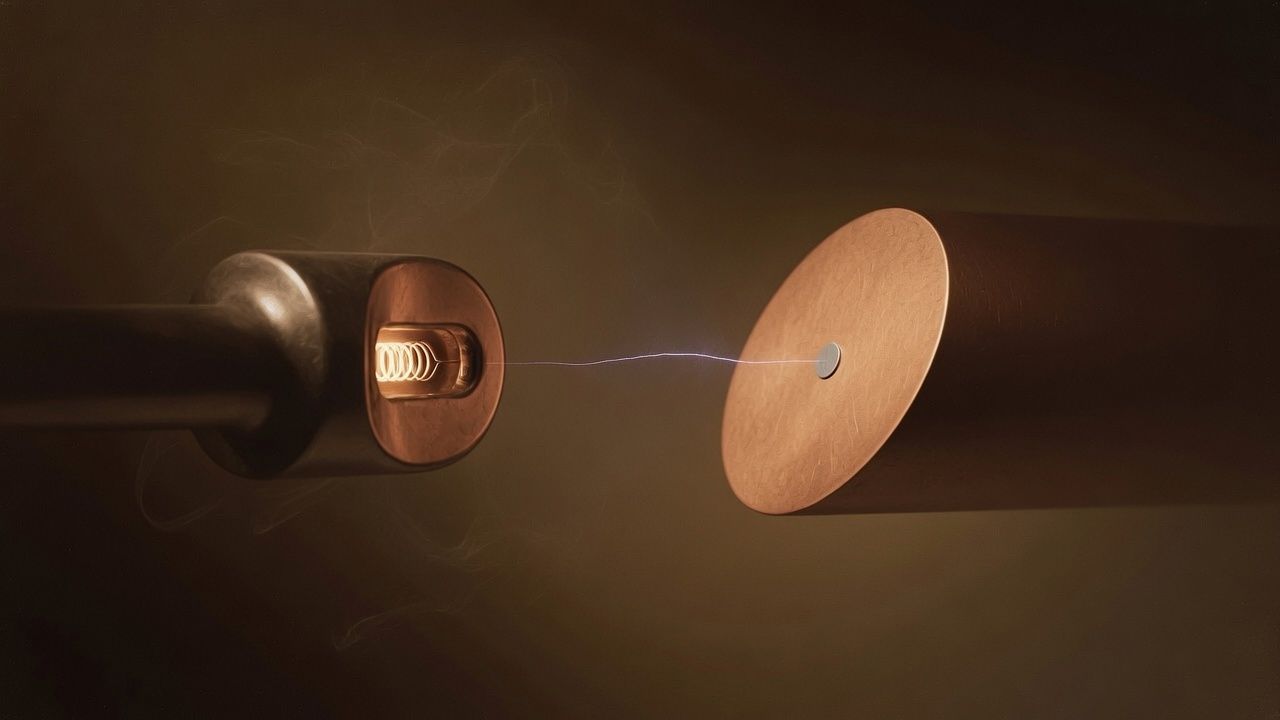
Push enough voltage across a gap in vacuum and, for a moment, nothing happens. Empty space is the best insulator there is. Then a single point on the metal, far too small to see, gives way. In under a microsecond the gap fills with plasma and shorts. The field calls it an arc, and every high-voltage tube ever built has had to be designed and processed to keep it from happening.
I have fought it from both ends of the scale. A 450 kV X-ray tube I built in industry, sealed, the size of a loaf of bread. An electron gun on an accelerator I bake today. The tube made photons, the gun makes a beam, and a fusion magnet next door wants neither, only to hold its voltage. Three machines that share nothing on the surface, afraid of the same thing underneath.
It is field emission, run away
It starts on the cathode surface, at one microscopic asperity. A sharp point multiplies the local field by a geometric factor, and the current emitted from that point climbs faster than anything else in the system. The current heats the tip, the tip melts and vaporizes, the metal vapor ionizes, and now there is a plasma where there was vacuum. The plasma shorts the gap. The arc sustains the very field that lit it.

Breakdown is processed out by conditioning
A fresh surface field-emits and breaks down at low voltage. You raise the voltage slowly, letting small breakdowns burn off the worst emitters and pump away the gas, and the surface cleans itself up until it holds. The rate at which the voltage rises is set by the breakdown rate, the same discipline as the bakeout.
Conditioning tracks the number of pulses. A breakdown damages the surface, and every new high-voltage program still counts breakdowns first. So you push pulses, and you stay below the breakdown rate you intend to run at. Each provoked spark adds damage to the surface being conditioned.
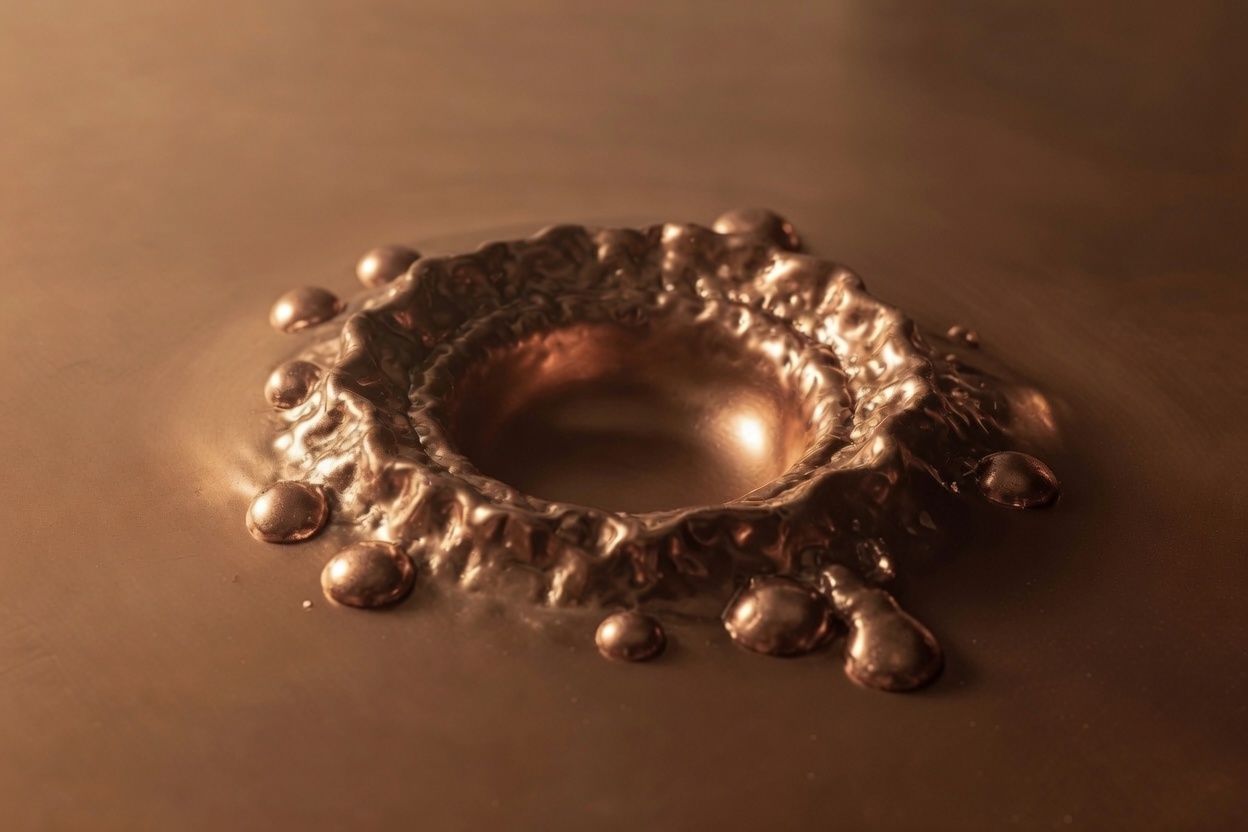
Two signatures you actually watch for
Dark current, the steady field emission below breakdown, is the precursor to watch. It signals a surface getting ready to fail. You watch it the way you watch a gauge drift.
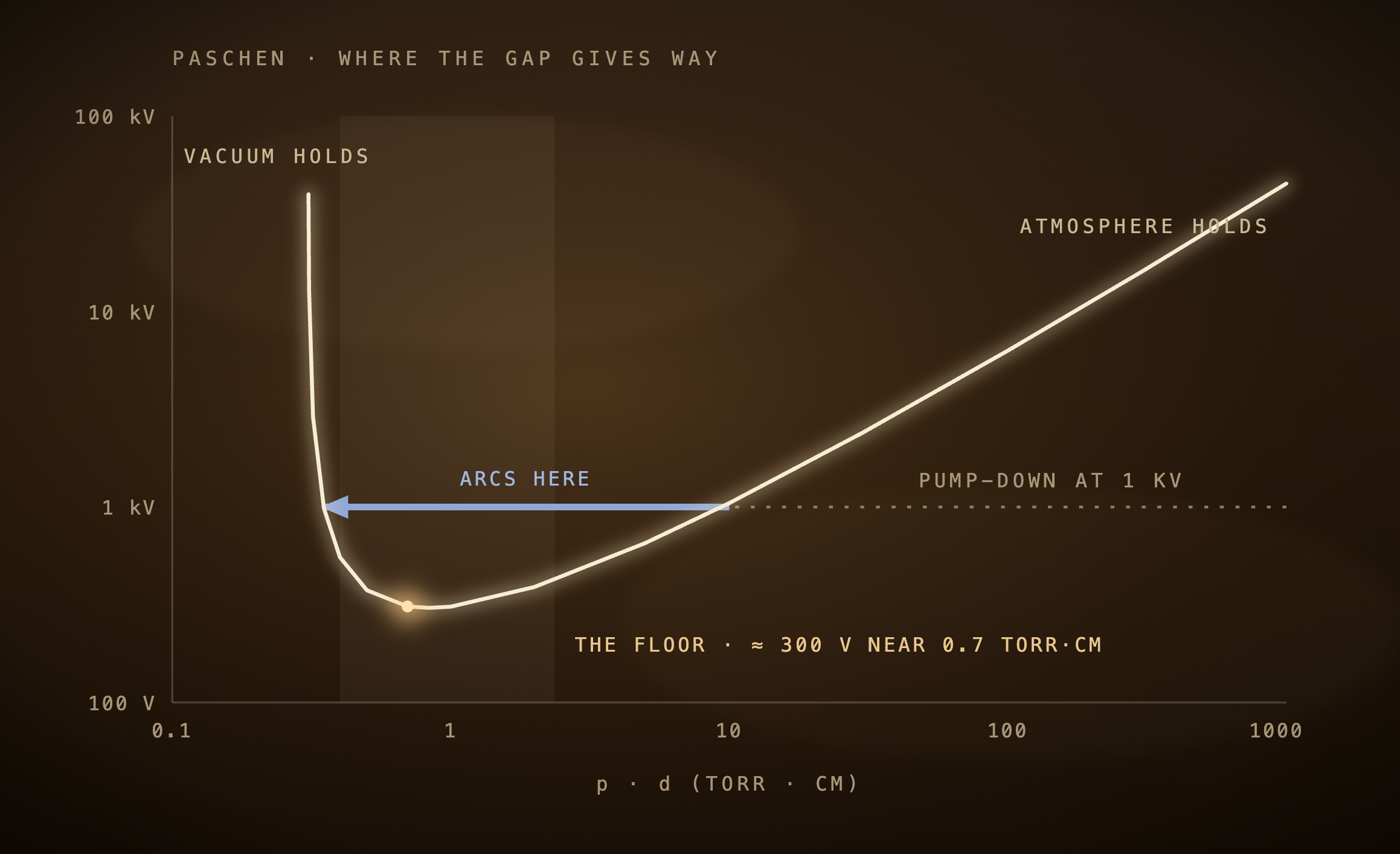
The Paschen strike is the one that bites beginners. Operating vacuum is safe and atmosphere is safe. The strike comes in between, during pump-down or venting, when the tube crosses the pressure where a few hundred volts will arc in gas the rest of the curve shrugs off.
Pulsed buys margin
Same surface, same metal. Run it DC and you hold near twice the Kilpatrick field. Pulse it under a millisecond and you reach near five times it. The reason is time: the arc has to heat and melt its way to a plasma, and a short pulse ends before it gets there. It is why a pulsed accelerator runs at gradients a DC gap would never survive, and why my DC X-ray tube had no such slack. Its only margin was a clean surface.
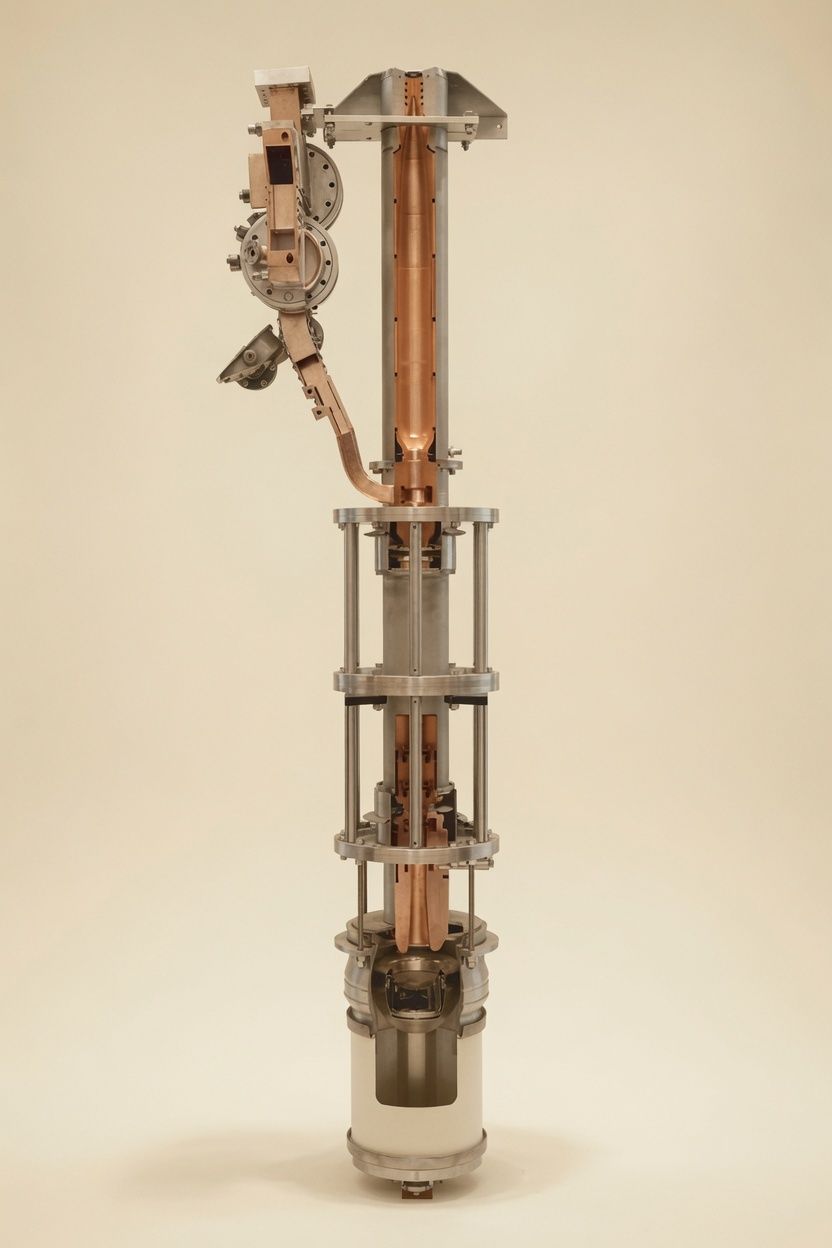
The same problem makes the photons
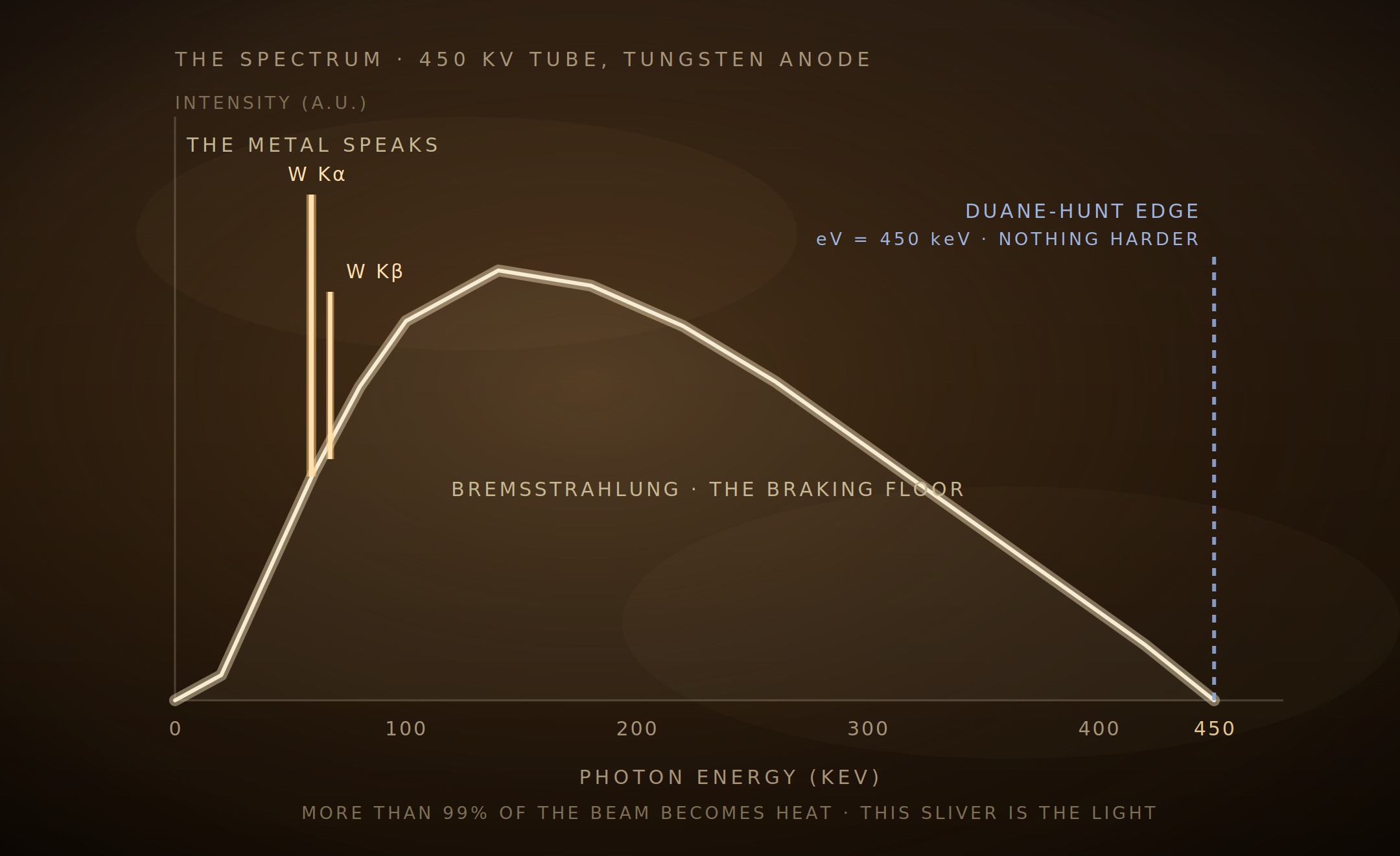
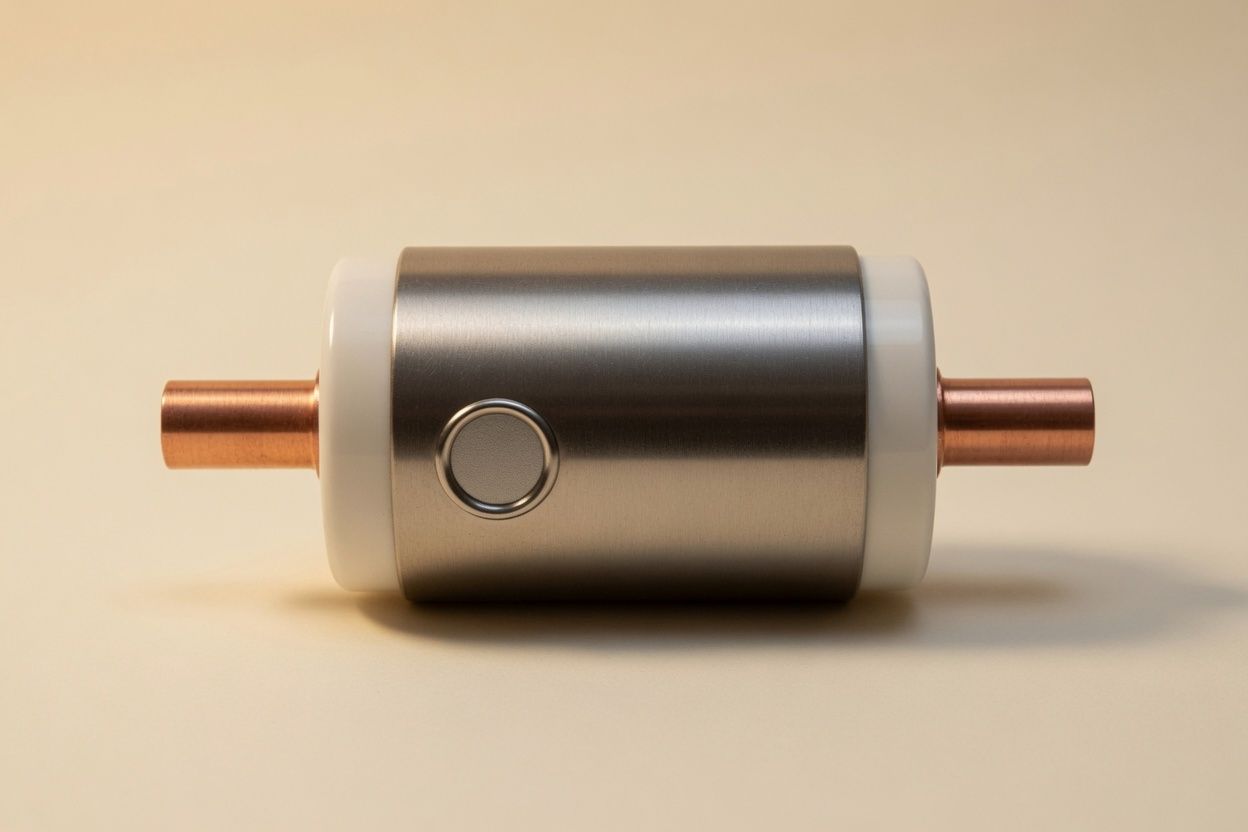
The X-ray tube is the other end of my career and the same physics. Electrons leave a hot cathode, cross the gap under the tube voltage, and stop in a tungsten anode. Most of that energy, about ninety-six percent of it, becomes heat, which is why the anode is tungsten. A sliver comes out as X-rays: a continuous bremsstrahlung floor, with sharp characteristic lines on top, set by the metal. And the hardest photon the tube can make is fixed by one number alone.
The RF-only failure, for completeness
One mechanism needs neither asperity nor gas. In an RF field an electron knocked off a wall can be driven back in phase to strike again and release more than one secondary. If the timing resonates and the yield exceeds one, the population multiplies, a multipactor. It loads cavities and cracks windows. It is a resonance rather than a cascade, so the cures are different: geometry, a surface that emits fewer secondaries, a bias field.
What can bite you
| Failure | Where | Mechanism | Fix |
|---|---|---|---|
| Vacuum arc | cathode, any HV surface | field emission at an asperity, runaway to plasma | clean, conditioned surface |
| Flashover | gun insulator, ceramic window | triple-junction emission along a dielectric | shaped junctions, clean ceramics |
| Dark current | high-field surfaces | sub-breakdown field emission | low-β geometry, no sharp edges |
| RF breakdown | output cavity, structure | pulsed surface field over the limit | lower gradient, more conditioning pulses |
| Multipactor | windows, couplers | resonant secondary-electron multiplication | geometry, low secondary yield, bias |
| Paschen strike | whole tube, at pump or vent | gas avalanche near the pressure minimum | pump and vent fast through the minimum |
The X-ray tube industry took forty years to learn this discipline. Accelerators are learning it now, and fusion magnets come next. The voltage at which empty space gives up is not a number you can design your way under once and forget. It is a line you walk every time you bring a machine up, pulse by pulse, watching the dark current, crossing the Paschen floor fast, never chasing a spark.
Sources · 13
- Latham, R.V., High Voltage Vacuum Insulation, Academic Press.
- Kilpatrick, W.D., Criterion for Vacuum Sparking Designed to Include Both rf and dc, Rev. Sci. Instrum. 28, 824 (1957).
- Slade, P.G., The Vacuum Interrupter: Theory, Design, and Application, CRC Press.
- Dyke, W.P. & Trolan, J.K., The Field Emission Initiated Vacuum Arc. I. Experiments on Arc Initiation, Phys. Rev. 91, 1043 (1953).
- Mesyats, G.A., Ecton mechanism of the vacuum arc cathode spot, IEEE Trans. Plasma Sci.
- Degiovanni, A., Wuensch, W., Giner Navarro, J., Comparison of the conditioning of high gradient accelerating structures, Phys. Rev. Accel. Beams 19, 032001 (2016).
- Loveless, A.M. & Garner, A.L., The Transition to Paschen's Law for Microscale Gas Breakdown at Subatmospheric Pressure, Sci. Rep. 9, 5669 (2019).
- Wangler, T.P., RF Linear Accelerators, 2nd ed., Wiley-VCH.
- Grudiev, A., Calatroni, S., Wuensch, W., New local field quantity describing the high gradient limit of accelerating structures, Phys. Rev. ST Accel. Beams 12, 102001 (2009).
- Palaia, A. et al., Effects of rf breakdown on the beam in the Compact Linear Collider prototype accelerator structure, Phys. Rev. ST Accel. Beams 16, 081004 (2013).
- Duane, W. & Hunt, F.L., On X-ray wave-lengths, Phys. Rev. 6, 166 (1915).
- Behling, R., Modern Diagnostic X-Ray Sources: Technology, Manufacturing, Reliability, CRC Press (2021).
- Parodi, R.F., Multipacting, CERN Accelerator School 2010, arXiv:1112.2176.
Ratings follow the Stack scale: [A] primary or standard, [B] manufacturer, [C] secondary. Links verified August 2026.