Brazing
A tube is sealed for life. Almost none of its joints can be reopened, so they are brazed, and brazing builds most of the tube.
Soldering, brazing and welding differ in what melts. Soldering melts a filler. Welding melts the base metals. Brazing sits in between: a filler melts, capillary action pulls it into a thin gap, and the parts never melt.
| Method | What melts | Melts at |
|---|---|---|
| Soldering | a filler | below 450 °C / 842 °F |
| Brazing | a filler | above 450 °C / 842 °F |
| Welding | the base metals | their melting point |
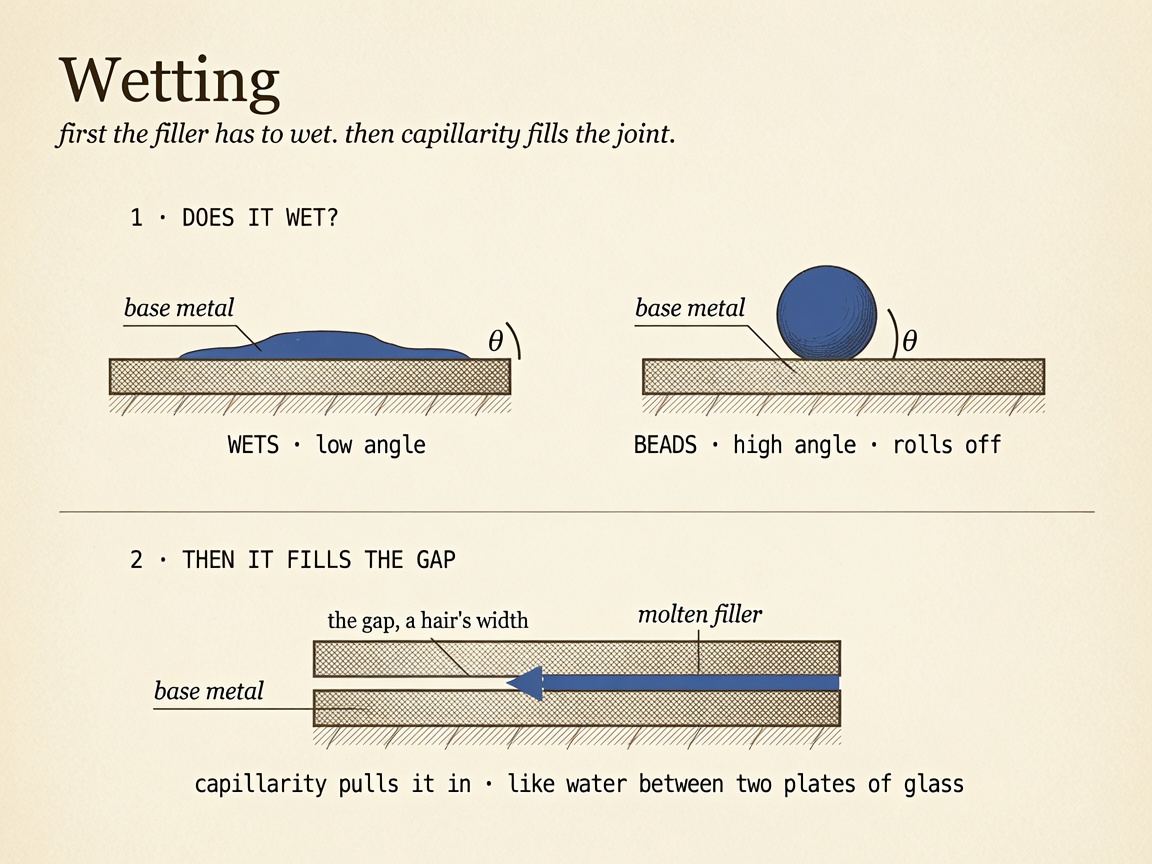
Capillary action is what pulls the molten filler in. It is the same force that lifts water between two plates of glass held close together. The tighter the gap, the harder it pulls.
But the filler only flows if it wets, and wetting is an energy balance. Where the drop meets the surface, three surface energies meet and settle at one contact angle.
The contact angle governs both wetting and bond quality. A low angle floods the joint, and a high angle beads up and rolls off, like water on a waxed panel.
On clean metal a non-reactive filler wets almost at once. It is just a thin liquid obeying capillarity, so nothing chemical has to happen first. An active braze on ceramic has to grow a wettable layer by reaction before it can spread, so it crawls.
| How fast it wets | non-reactive · Ag/Cu, Au/Cu | active · Ti |
|---|---|---|
| limited by | flow only | the reaction |
| spreading front | > 10 mm/s | reaction-limited |
| reaches its angle in | ≈ 10-100 ms | ≈ 1-100 s |
| melt viscosity | a few mPa·s (≈ water) | a few mPa·s |
Wetting only puts the filler in contact. The bond is built on top of that. First comes van der Waals, the weak attraction between any two close surfaces, always present and on its own feeble. Then the joint that holds, and it splits by material. Metal to metal, atoms of filler and base share electrons and diffuse across the line, alloying a thin seam that belongs to neither side. Metal to ceramic, the filler cannot alloy with an oxide, so it reacts with it and builds a new compound it can hold onto.
The gap values below apply at brazing temperature.
| Rule | Joint gap |
|---|---|
| G1 | Joint clearance 0.025 to 0.127 mm (0.001 to 0.005 in), slip fit, held at brazing temperature. |
| R14 | 0.025 to 0.125 mm held at brazing temperature |
Then the surface. A braze only takes on clean, bare metal. An oxide skin blocks wetting cold, and the filler will sit there molten without flowing, however hot it gets. Surface preparation to remove the oxide skin is therefore mandatory, and the method depends on the base metal and on how the face was machined.
A handful of filler families do almost all vacuum and tube work, named by their major metal.
| Alloy | Mix | Melts | Where it goes |
|---|---|---|---|
| Indalloy 182 / 80Au/20Sn solder | Au 80 / Sn 20 | 280 °C solidus | no base named |
| 4047 / BAlSi-4 / AL 104 | Al 88 / Si 12 | 577-582 °C solidus to liquidus | no base named |
| Incusil 15 / BAg-29 | Ag 61.5 / Cu 24 / In 14.5 | 605-725 °C solidus to liquidus | nickel 200, Kovar |
| BAlSi-2 / AL 4343 / AA 4343 / EN AW-4343 / UNS A94343 | Si 7.5 / Al bal | 617-672 °C brazing window | no base named |
| Incusil 10 | Ag 63 / Cu 27 / In 10 | 685-730 °C solidus to liquidus | nickel 200, Kovar |
| Incusil-ABA / APA-7 Ti-active | Ag 59 / Cu 27.25 / In 12.5 / Ti 1.25 | 715-740 °C brazing window | no base named |
| Cusin-1 ABA Ti-active | Ag 63 / Cu 34.25 / Ti 1.75 / Sn 1 | 775-806 °C solidus to liquidus | no base named |
| Cusil-ABA Ti-active | Ag 63 / Cu 35.25 / Ti 1.75 | 779-816 °C solidus to liquidus | no base named |
| Cusil / BAg-8 | Ag 72 / Cu 28 | 780 °C solidus | Kovar, nickel 200 |
| Ticusil Ti-active | Ag 68.8 / Cu 26.7 / Ti 4.5 | 780-900 °C solidus to liquidus | Kovar, nickel 200, graphite |
| Palcusil 10 | Ag 58 / Cu 32 / Pd 10 | 824-852 °C solidus to liquidus | no base named |
| Palcusil 15 | Ag 65 / Cu 20 / Pd 15 | 850-900 °C solidus to liquidus | Kovar, nickel 200 |
| Nicoro-80 | Au 81.5 / Cu 16.5 / Ni 2 | 910-925 °C solidus to liquidus | no base named |
| TiCuNi / EP 0238433 Ti-active | composition not read | 925-945 °C solidus to liquidus | no base named |
| Nioro / BAu-4 / AMS 4787 | Au 82 / Ni 18 | 955 °C solidus | Kovar, nickel 200 |
| 35Au/65Cu | Au 35 / Cu 65 | 990-1010 °C solidus to liquidus | no base named |
| BNi-2 / Nicrobraz LM / AMS 4777 | Cr 7 / B 3.1 / Si 4.5 / Fe 3 / Ni bal | 1010-1175 °C brazing window | no base named |
| 35Au-62Cu-2Ti-1Ni / 62Cu-35Au-2Ti-1Ni Ti-active | Au 35 / Cu 62 / Ti 2 / Ni 1 | 1015-1026 °C solidus to liquidus | no base named |
| BAu-1 / 37.5Au-62.5Cu | Au 37.5 / Cu 62.5 | 1016-1093 °C brazing window | no base named |
| BNi-1 | composition not read | 1066-1204 °C brazing window | no base named |
| BCu-1 | Cu 100 | 1093-1149 °C brazing window | no base named |
| Palco / BPd-1 | Pd 65 / Co 35 | 1219 °C solidus | nickel 200 |
| Cu-TiH2-Ni Ti-active | composition not read | no melting data read | no base named |
| Nicusil 3 | Ag 71 / Cu 28 / Ni 1 | no melting data read | no base named |
| 97Ag-1Cu-2Zr / Ag-1Cu-2Zr Ti-active | Ag 97 / Cu 1 / Zr 2 | no melting data read | no base named |
| Ag-31.5Cu-10Pd | Cu 31.5 / Pd 10 / Ag bal | no melting data read | no base named |
| 60Zr-25V-15Cb Ti-active | Zr 60 / V 25 / Nb 15 | no melting data read | no base named |
| 50Zr-30V-20Cb Ti-active | Zr 50 / V 30 / Nb 20 | no melting data read | no base named |
| 56Zr-28V-16Ti Ti-active | Zr 56 / V 28 / Ti 16 | no melting data read | no base named |
| 35Nb-65V | Nb 35 / V 65 | no melting data read | no base named |
| pure vanadium | V 100 | no melting data read | no base named |
| 50Cu-40Pd-10Ni | Cu 50 / Pd 40 / Ni 10 | no melting data read | no base named |
| palladium | Pd 100 | no melting data read | no base named |
| 48Ti-48Zr-4Be Ti-active | Ti 48 / Zr 48 / Be 4 | no melting data read | no base named |
| 49Ti-49Cu-2Be Ti-active | Ti 49 / Cu 49 / Be 2 | no melting data read | no base named |
| 13In-27Cu-60Ag | In 13 / Cu 27 / Ag 60 | no melting data read | no base named |
| 10Sn-30Cu-60Ag | Sn 10 / Cu 30 / Ag 60 | no melting data read | no base named |
| 71.5Ti-28.5Ni / Ni/Ti eutectic 28.5:71.5 Ti-active | Ti 71.5 / Ni 28.5 | no melting data read | no base named |
The 38 documented fillers of the brazing corpus, lowest set temperature first: that is the order a step-brazed stack closes in. Derived at build. Composition and mix, as shown above, are on the braze-alloys card of /data/matter-materials.json. Rules, curves, pairs and geometries are at /data/brazing.json.
The cadmium and zinc ban. The cheapest silver brazes carry cadmium and zinc to lower their melting point, and both metals are forbidden in a vacuum tube. Those metals boil off, foul the furnace, then evaporate inside the running tube and kill its vacuum. Tube work uses the vacuum grades, cadmium and zinc held to a few thousandths of a percent.
Forms
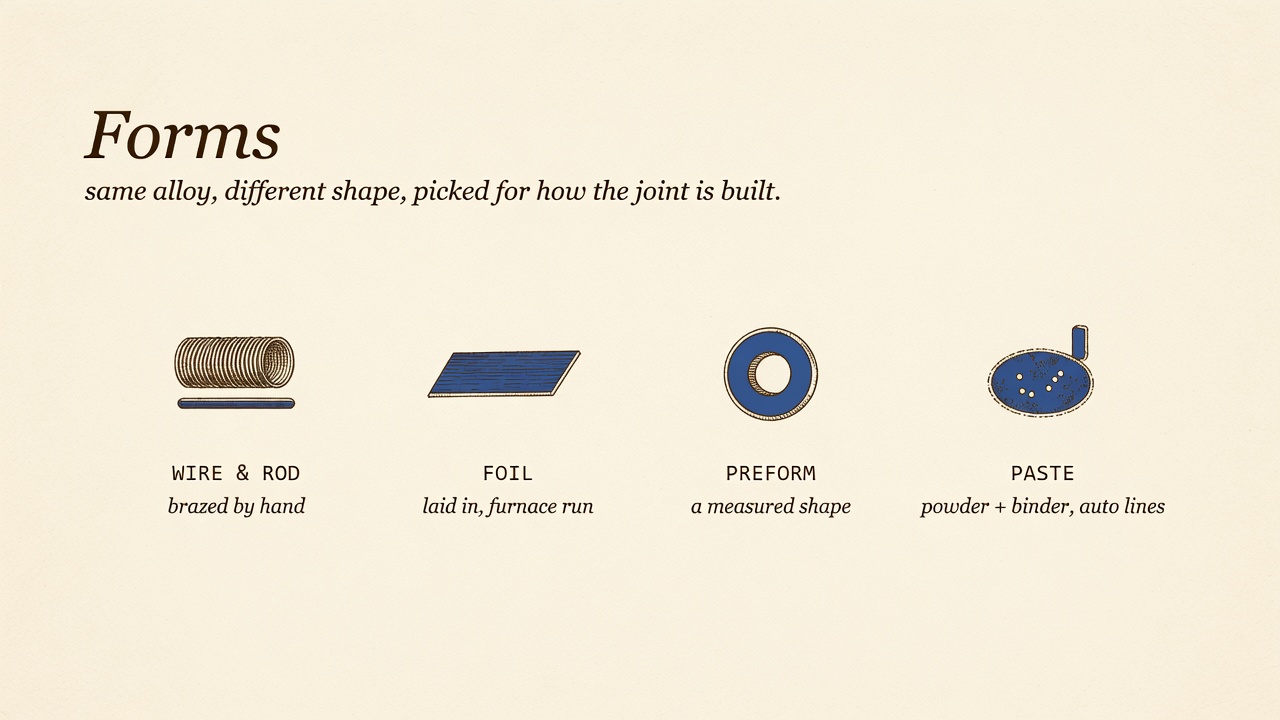
The same alloy ships in several shapes, and you pick the shape for how the joint is built: wire and rod for brazing by hand, thin foil and stamped preforms laid straight in the joint for a furnace run, and paste (powder in a binder) for automated lines. Foil and preforms set a measured amount in a tight, clean gap. Paste and powder carry a binder that has to be burned off first.
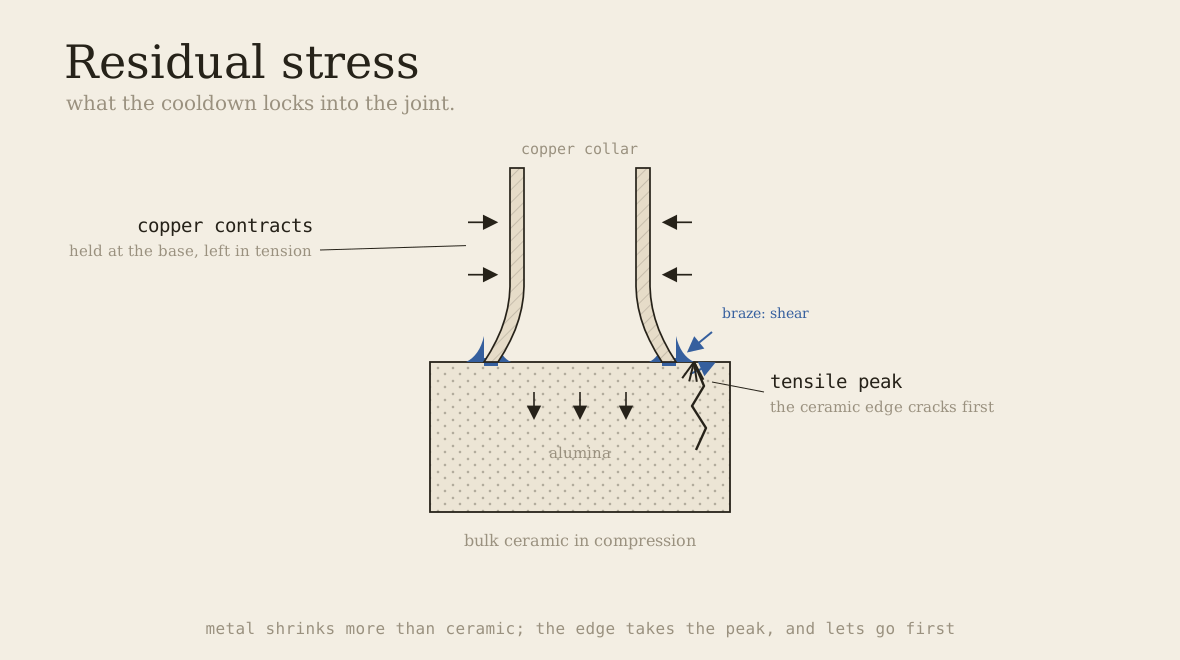
The plain case. A brazed joint usually fails on the way down from heat, when two metals with different expansion coefficients contract by different amounts and tear the seam apart. So tubes lean on alloys cut to expand like the glass and ceramic they seal to, above all Kovar.
| Material | Expansion (ppm/K) |
|---|---|
| Kovar · molybdenum · borosilicate glass | ~5 |
| Alumina | ~7 |
| Stainless 304 · copper | ~17 |
- stainless 316L to 1370.85 °C
- copper OFE to 927 °C
- nickel to 1000 °C
- beryllium to 1027 °C
- Kovar to 900 °C
- BeO to 2026.85 °C
- niobium to 2026.85 °C
- sapphire to 1017 °C
- titanium grade 2 to 700 °C
- aluminum 6061 to 300 °C
- alumina to 1626.85 °C
- tantalum to 1000 °C
- molybdenum to 1000 °C
- AlN to 1426.85 °C
- tungsten to 1000 °C
- graphite to 1500 °C
- SiC to 800 °C
- CVD diamond to 800 °C
not drawn: Schott 8250. no sourced curve yet.
- Kovar table ends 900 °C. end of source table
- titanium grade 2 table ends 700 °C. last temperature the RP1520 table tabulates a mean coefficient for on sample 1641A, 700 C
- aluminum 6061 table ends 300 °C. end of the cited mean ranges (solidus 582 C, well below brazing set temperatures of the corpus)
Drawn at build from the 18 sourced curves of the brazing corpus, each stopped at the end of its own table. The 15 vertical marks are the documented filler set temperatures that fall inside this range: Palco sets at 1219 °C, past the right edge. Nothing is extrapolated. Full data at /data/brazing.json, interactive at the brazing abacus.
The materials fall into a low-expansion group near 5 ppm/K and a high-expansion group near 17 ppm/K. A joint between the two needs a ductile filler such as gold-nickel to absorb the mismatch. For a copper-to-stainless edge the usual practice is to braze inside and weld outside.
The hard half. A tube is full of ceramic, in its insulators, RF window and feedthrough bodies, and a plain silver-copper braze beads off bare alumina like water on wax. The filler holds itself together more strongly than the bare oxide pulls on it, so it balls up and rolls off. To braze a ceramic you have to change that surface until the metal wants to spread on it. There are two routes, and both create a metal-wettable surface: one builds it onto the ceramic before brazing, the other grows it with the filler in one shot.
Route 1: metallize first (the classic)
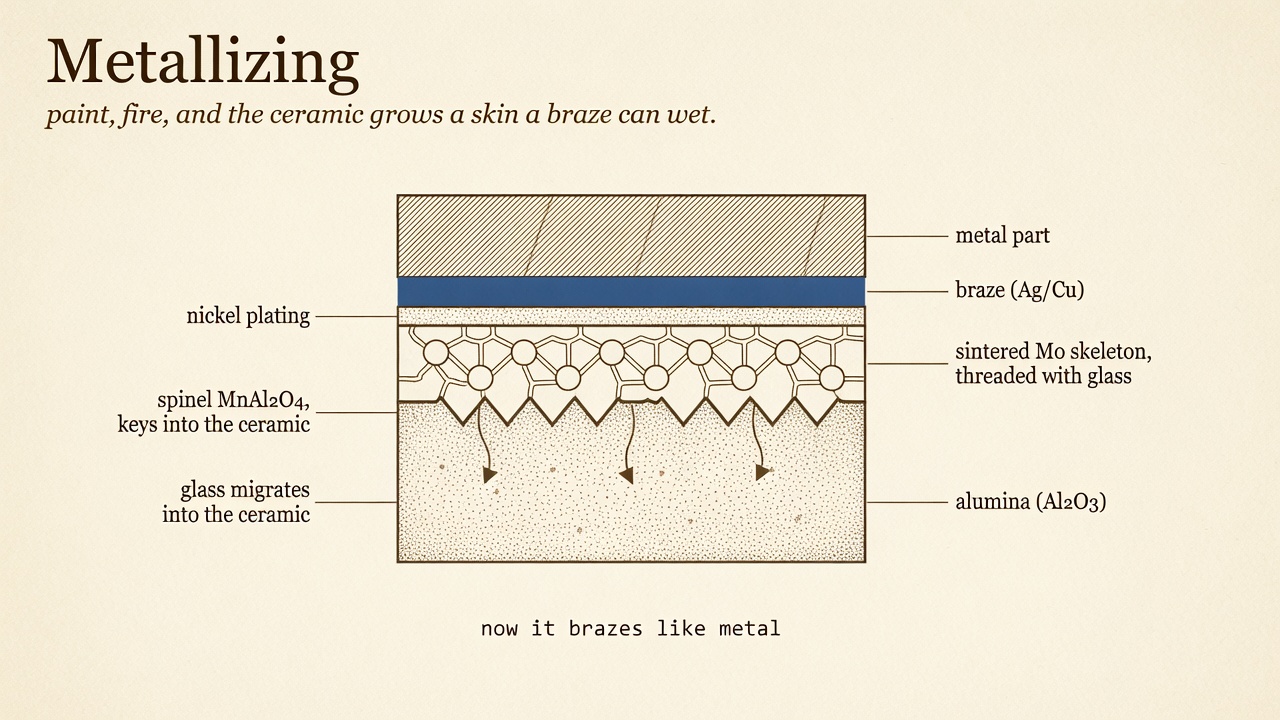
The older, production-proven route. You grow a thin, metal-bonded skin on the alumina, then braze to that skin like any metal. On alumina, in order:
- the ceramic is often air-fired on receipt, to burn off shop dirt and set a clean oxide before anything else touches it,
- it is painted with a moly-manganese ink (molybdenum powder, manganese and a little glass frit) by brush, screen or robot,
- it is dried,
- then it is fired in wet hydrogen, and the water vapour in the gas is what oxidises the manganese.
Dry hydrogen would leave everything bare metal. The trace of water changes that for one element only. Manganese pulls hard enough on oxygen that the water oxidises it to MnO, while the molybdenum, which has to stay metal, is left alone. The dividing line is the dew point of the gas: it sets the water-to-hydrogen ratio, and that ratio sets how much oxygen is on offer. At the right dew point the manganese oxidises and the molybdenum stays metallic, which is why houses guard their dew-point settings.
The MnO dissolves into the thin glass alumina already carries between its grains, thins it, and that glass, now mobile, is pulled by capillary force into the pores of the ceramic and up into the molybdenum painted on top. Where it meets the alumina it crystallises as a manganese-aluminate spinel, MnAl2O4, locked into the ceramic lattice. At the same time the molybdenum powder sinters into a continuous skeleton, keyed to the surface and threaded with that glass. Cooled, it leaves a layer that is metal on the outside and chemically rooted in the ceramic below, a few tens of microns of skin a braze will wet.
- it is plated with nickel (or copper) and fired again under hydrogen, so the plating keys to the moly and the braze flows clean,
- now it brazes like metal, and silver-copper does the rest.
The settings stay in-house. The atmospheres (pure hydrogen, or a 90/10 mix), the dew points, the temperatures and the dwell times are bench lore, and they change from one house to the next.
Route 2: active braze (one firing)
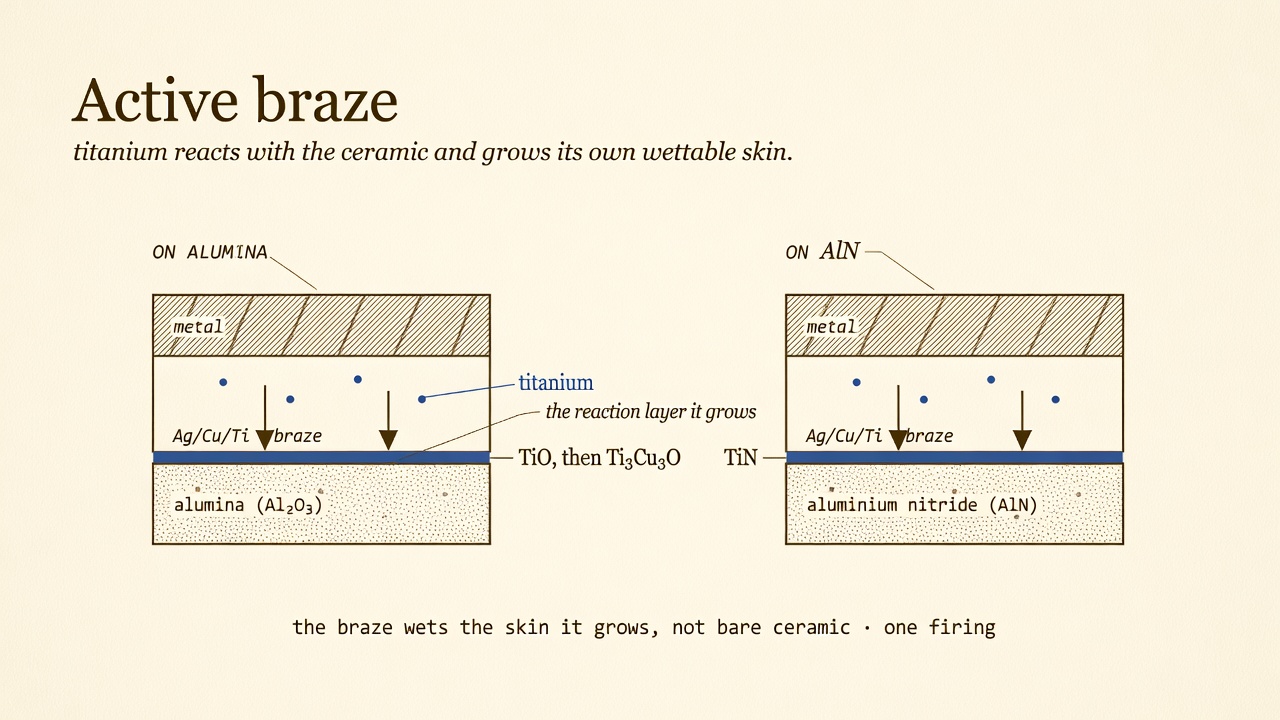
Put the reactive metal in the filler and let it build the wettable surface in place. A little titanium, carried in the molten silver-copper, finds the oxygen locked in the alumina and reacts with it right at the interface. What it grows is a thin, titanium-rich layer, far closer to a metal than the ceramic was, and the braze wets that. One firing instead of three.
The filler wets the titanium-rich reaction layer it forms on the ceramic. As the titanium reacts, the interface it leaves behind has a much lower energy than bare alumina, so the contact angle collapses, from a bead that rolls off, past the 90° line where wetting begins, down toward 10–20°. The reaction takes time and runs in stages: first the liquid creeping along the joint, then titanium diffusing to the front, then the reaction itself. Too short and the layer is patchy, too long and it grows brittle and thick, so the dwell time has an optimum between the two.
What the layer is depends on how much titanium is active at the surface. Lean, and you get a simple titanium oxide, TiO. Richer, and a copper-titanium-oxide compound, Ti3Cu3O, builds along the interface instead. Either one carries enough metallic character for the braze to take hold.
And the ceramics get harder as you go. Alumina takes both routes easily. Aluminium nitride needs the active route, and it can throw brittle phases you have to design around. Boron nitride is the hardest case: molten fillers barely wet it, and few shops braze it cleanly.
Brazed joints fail in three ways.
1 · Cooldown
The expansion mismatch, worst across metal-to-ceramic. A brittle filler or a bad geometry cracks cold.
2 · Scavenging
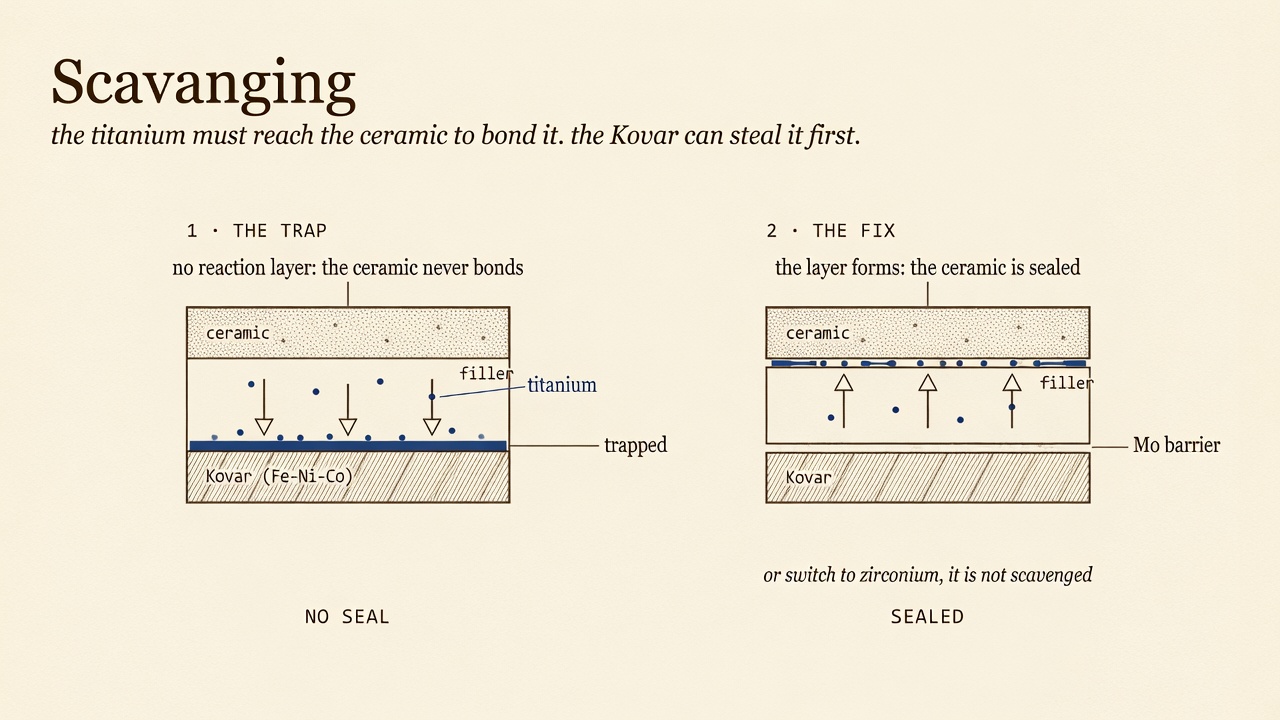
Braze Kovar, or any iron-nickel-cobalt, to ceramic with a titanium-active filler, and the iron and nickel eat the titanium before it reaches the ceramic. Without the reaction layer there is no seal.
No visible defect. The joint shows nothing until it is leak-tested. Block it with a thin molybdenum barrier, or switch the active metal to zirconium, which does not scavenge.
3 · Volatiles
The cadmium and zinc ban applies here too, and a titanium-active braze also needs a good furnace vacuum, or the titanium oxidises.
The crossing
A fusion first wall bonds tungsten to copper and cycles it to plasma heat. A quantum cryostat rides the same mismatch down to a few millikelvin. Fusion first walls, cryostats and X-ray tubes share the same three failure modes: cooldown stress, scavenging and volatiles.
Who designs, supplies and studies brazing and high-temperature joining, worldwide. Filter by region.
Palo Alto, US
Vacuum electronicsTWTs, klystrons, precision vacuum brazing
California, US
Ceramic-metalActive braze, hermetic assemblies
California, US
Ceramic-metalBrazed ceramic-metal, hermetic packages
San Diego, US
Fusion W-CuPlasma-facing components, HIP
Clinton, US
SinteringAg and Cu sinter paste, NanoFoil reactive foil
Michigan, US
Nickel fillersNicrobraz fillers, aero brazing
Ohio, US
Filler metalsPrecious and Ti-bearing fillers, seal materials
Arizona, US
AMB substratesSi3N4 active metal brazed substrates
Salt Lake City, US
X-ray tubesX-ray tubes, ceramic-metal seals
Tennessee, US
Nuclear joiningSiC/SiC joining, diffusion bonding
New Mexico, US
Hermetic sealsGlass-metal and ceramic-metal seals
California, US
AcceleratorsOFE copper RF, UHV brazing
Ohio, US
Process transferIndustrial brazing and diffusion bonding
Osaka, Japan
Joining scienceActive braze, TLP, laser brazing
Harbin, China
Ceramic-metalHEA fillers, CMC joining, reinforced fillers
Kyoto, Japan
UHV feedthroughsCeramic-metal, AMB substrates, feedthroughs
Japan
Fusion divertorTungsten monoblocks, HIP, series qualification
Zhengzhou, China
Braze fillersBrazing alloys, flux, R&D
Japan
Die-attachSinter paste for power modules
Tokyo, Japan
Precious fillersAu, Ag, Pd fillers, sinter paste
Nagoya, Japan
Ceramic-metalTechnical ceramics, ceramic-metal assemblies
Tokyo, Japan
Die-attachSolders and sinter paste
Osaka, Japan
SinteringAg sinter paste, solders
Korea
ManufacturingBrazing, electronic packaging
Beijing, China
Amorphous foilsNi amorphous brazing foils for diffusion
Taiwan
Power electronicsJoining, packaging, power modules
Germany
Ceramic joiningHigh-temperature joining, active braze
France
Diffusion bondingW-Cu for ITER, heat exchangers
Switzerland
AcceleratorsVacuum brazing, OFE copper
Austria
Refractory metalsX-ray anodes, fusion tungsten, brazed parts
Germany
Hermetic sealsGlass-to-metal seals, feedthroughs
United Kingdom
Active brazeCusil, Ticusil, Incusil active fillers
Germany
Die-attachAg and Cu sinter paste, AMB substrates
Germany
Filler metalsSilver and gold fillers
France
QualificationNational braze reference, ATG Brasures
France
Hermetic packagesPackages and feedthroughs
United Kingdom
Diffusion bondingDiffusion bonding and brazing R&D
Sources · 15
- Filler families, brazing > 450 °C, AWS A5.8 specification.
- Metallurgical bond by interdiffusion (metal-metal), review, Brazing filler metals (Int. Mater. Rev.).
- Wetting to van der Waals to chemical bond, adsorption theory of adhesion (ScienceDirect).
- Wetting kinetics: non-reactive spreading in tens of milliseconds, front >10 mm/s; reactive wetting in seconds to minutes, Eustathopoulos et al., SIMaP, Grenoble (J. Mater. Sci. 45, 2010).
- Mo-Mn in wet hydrogen: Mn-aluminate spinel, glass migration, ScienceDirect / US Patent 3,537,888.
- Gold-nickel 82/18, wets W-Mo-SS, SAE AMS 4787.
- Kovar Fe-Ni-Co, expansion match to glass/alumina, ScienceDirect / ASM.
- Active brazing: Ti reaction layer, contact angle ~80° to ~10°, Nature Sci. Reports / Eustathopoulos.
- Ti scavenging by Fe-Ni-Co; Mo barrier / Ag-Cu-Zr fix, Sandia (OSTI 15199).
- Cusil/Cusin/Ticusil compositions; Mo-Mn + nickel route, Morgan / Wesgo.
- Vacuum-grade fillers (BVAg), Cd/Zn ban, Lucas-Milhaupt.
- Braze forms (wire, foil, preform, paste); step brazing of tubes, ASSEMBLY / trade.
- Lucas-Milhaupt, Tips for Designing Braze Joints (blog) et Principles of Joint Design (Brazing Academy), lucasmilhaupt.com
- Haynes International, Brazing and Soldering, implementation guide
- Stroppa et al., Calculating Joint Clearance at Brazing Temperature, Welding Journal, September 2010 (brazing ranges by AWS classification)
Rated [A] primary, [B] manufacturer, [C] trade (cross-checked).