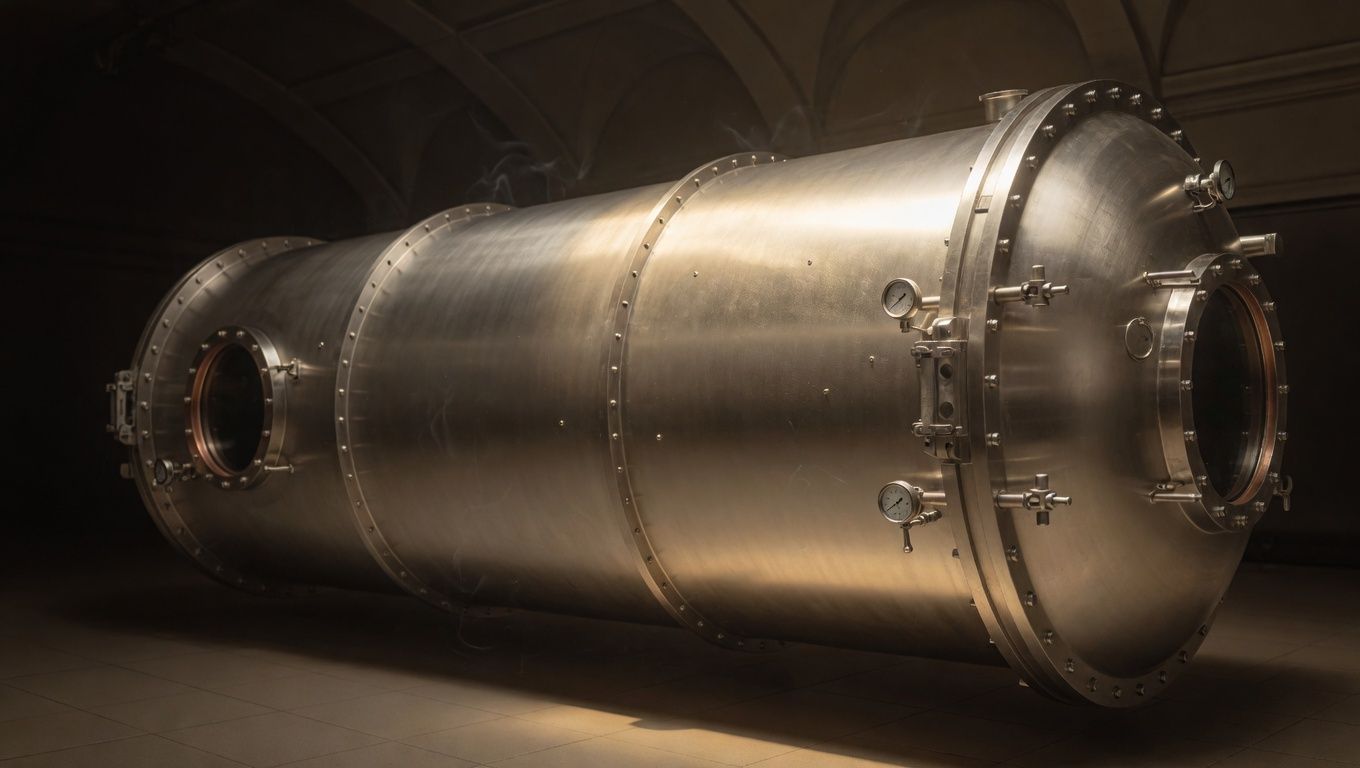
Somewhere this year, a steel chamber is being sealed shut. It is enormous. Inside it, magnets cold enough to touch the temperature of deep space. The chamber has one job before anything else can happen. It has to hold a vacuum, a deep one, as clean as the surface of the Moon.
They pump it down. The gauge falls toward nothing. And then the chamber starts to breathe.
Not air. There is no leak. The walls themselves are letting go of gas, molecule by molecule, from steel that looked perfectly solid. The pressure stops falling. It even climbs. The vacuum they just built is being spoiled from the inside, by the chamber itself. The field has a plain word for this. Outgassing. Everything does it. Metal, glass, a fingerprint, a weld. Seal anything into a vacuum and it will quietly exhale for days.
I have met this wall three times, in three worlds that do not talk to each other. An X-ray tube in industry, a sealed object the size of your hand. A synchrotron, a ring of light, where the vacuum is the condition for the beam to exist at all. And a large accelerator, a free-electron laser, where I bake chambers today and read what comes off their walls. From a tube you can hold to a machine a kilometer long. Three scales, one problem. The vacuum did not care which one I was standing in.
That is the strange and beautiful thing. The physics underneath is the same everywhere. The cultures are not. A field that has spent forty years on small sealed tubes knows things in its bones that a young, fast-moving field has not yet had reason to learn. And the reverse is true too. Nobody owns this knowledge. It just gets paid for, again and again, in different rooms.
So here is what the vacuum teaches, every time, whatever you are building.
Water is the patient enemy. It clings to every surface as a thin invisible film, and at room temperature it leaves on its own slow schedule, far too slow. So you heat the whole chamber and drive the water off before it can leave during the work that matters. We call it a bakeout, and the cost of it tells you how stubborn the gas is.
On the electron gun I work on now, we bake at 150 °C for about a week. On a 450 kV X-ray tube I built earlier, the bake ran above 400 °C for three weeks. Same gesture, wildly different price. The cleaner and the higher the voltage you need, the more you pay to get there. It is patience more than cleverness. You pay the debt early so it does not come due at the worst moment.
Materials have a memory. Whatever a metal absorbed during its life, it gives back later, under heat and vacuum. So you choose a material for what it will not say later. The wrong alloy, the wrong oil, a polymer that seemed harmless, and your clean vacuum is ruined by a decision made months earlier. Half the craft is refusing materials that will betray you down the line.
And what you cannot remove, you trap. The oldest trick in the sealed tube is the getter, a small patch of reactive metal that silently captures stray gas and holds it for the life of the device. It is a hundred years old. It powered the radio valves your grandparents listened to. And it never left. Open the packaging of a superconducting quantum chip today and you can find the same idea, a getter keeping a few cubic centimeters clean enough for a qubit to survive. A hundred-year-old vacuum-tube trick, holding up the most modern machine we know how to build. The same physics, reaching across a century.
None of this is secret. It is the ordinary discipline of anyone who works with empty space. But it was learned the hard way, over decades, mostly by people building things that have nothing to do with each other.
The tube wanted a clean image. The accelerator wants a clean beam. The fusion machine wants a clean plasma. Three goals that share nothing on the surface, sitting on one discipline underneath. A lesson one world paid for in full, another world can simply borrow. It does not have to be bought twice.
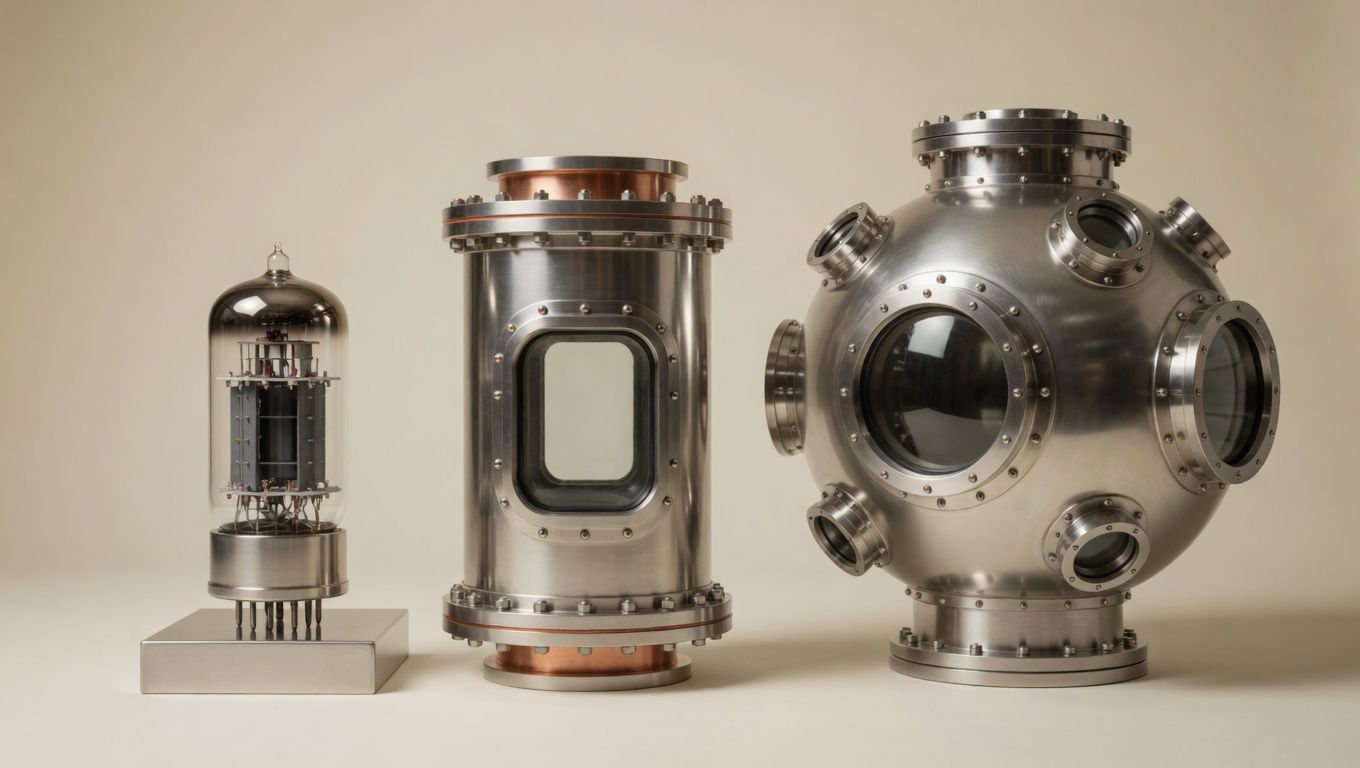
The vacuum does not know whether the chamber around it makes X-rays or makes a star. It exhales from the walls, it hides water in the corners, it remembers what the metal absorbed. Empty is empty.
I have had the rare luck of meeting it from both ends of the scale. That is the only reason I can say it out loud. The walls between these worlds are mostly habit. The physics underneath was never divided.
Sources · 3
- Redhead, P.A., Recommended practices for measuring and reporting outgassing data, J. Vac. Sci. Technol. A 20, 1667 (2002).
- Chiggiato, P., Outgassing, CERN Accelerator School: Vacuum for Particle Accelerators (CERN Yellow Reports).
- O'Hanlon, J.F., A User's Guide to Vacuum Technology, 3rd ed., Wiley, 2003 (outgassing chapters).
Ratings follow the Stack scale: [A] primary or standard, [B] manufacturer, [C] secondary.