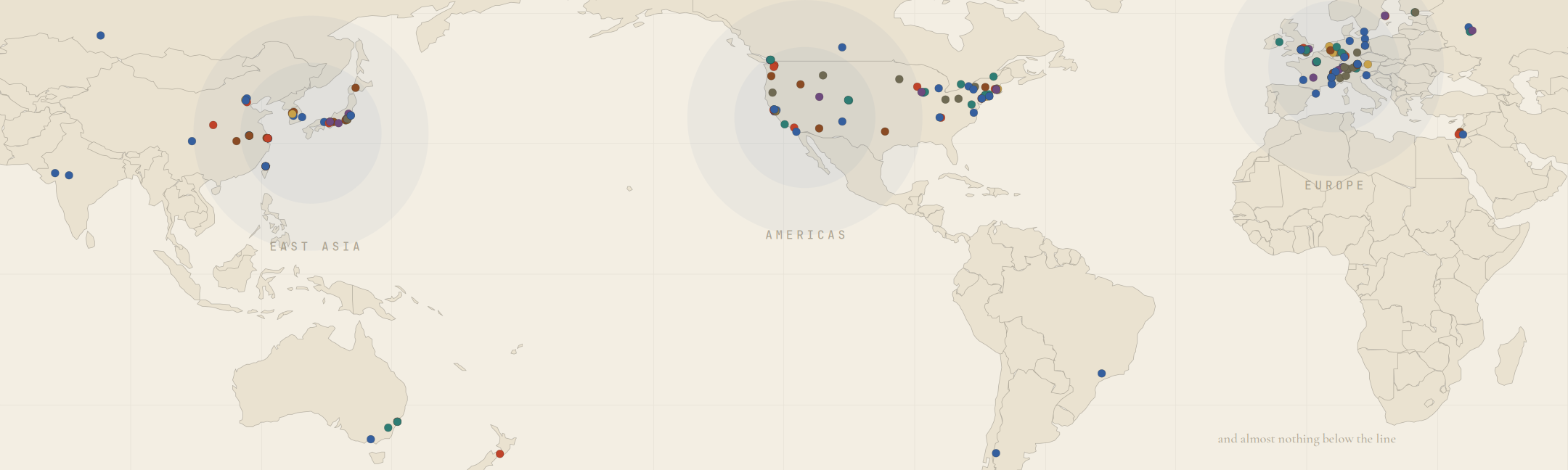
I placed every company and laboratory that touches ultra-high vacuum onto a single map, two hundred and thirty-five of them, each pinned to the city where it sits. I did it to see the field I work inside from above, the way I watch a bake from a screen instead of standing at the chamber. The map made an argument on its own, before I had written a word beneath it.
The pins crowd into three places, the American coasts, a band of small countries along the Rhine and the Alps, and a tight arc across Japan, Taiwan and Korea. Below the equator there is almost nothing. The emptiness that every frontier machine is built around, that fabs and colliders and fusion reactors depend on, is held up by three regions and left alone by the rest of the planet.
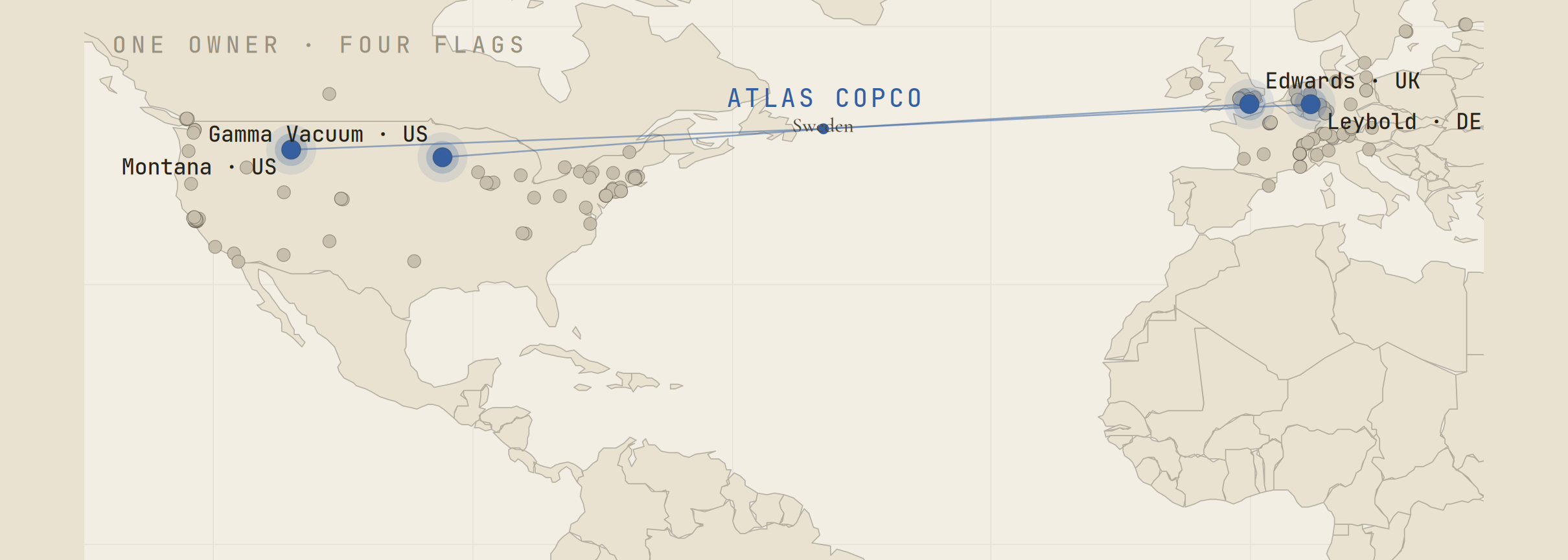
The ownership data shows a second pattern. The pumps that hold the world’s vacuum carry famous names, and those names are owned by a few holding companies you would never stencil on a chamber. One Swedish group, Atlas Copco, controls Edwards in England, Leybold in Germany, and Gamma Vacuum and Montana Instruments in the United States, four of the names I trust on my own stations, flying flags of three nations, all steered from a fourth. Busch, a German group, holds Pfeiffer, and Pfeiffer in turn bought Nor-Cal Products. The consolidation stops short of the headline names that fill every article about chips. ASML stands alone, TSMC stands alone. The gathering is one layer down, on the ion pumps and the cryostats and the gauges, the parts nobody cites. Ownership changes hands at that level, among component makers that draw little press coverage.
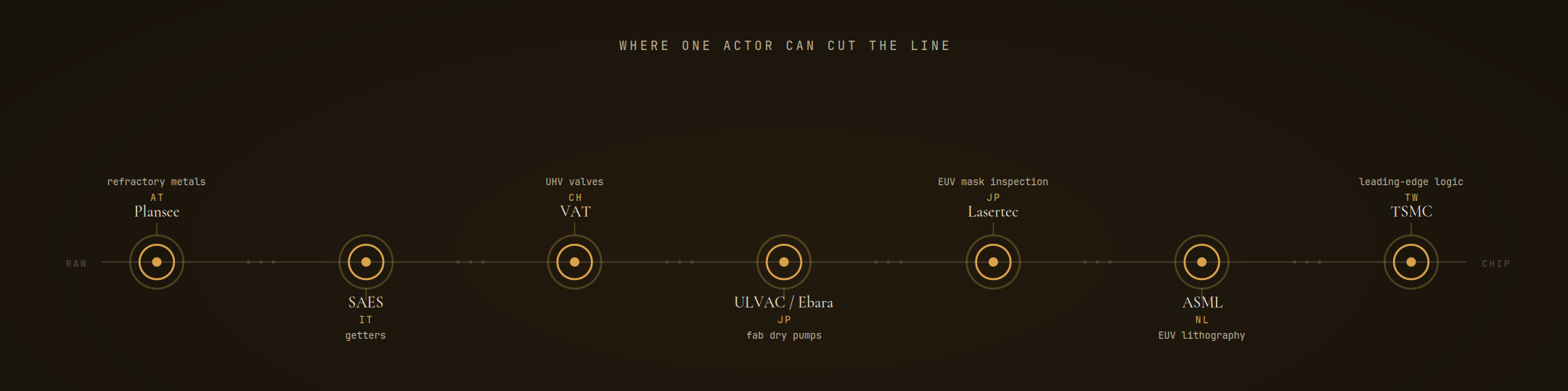
A handful of these actors also gate what they make. The list is short, and every entry is a single point where one failure, or one export order, stops the line. The table below lists seven such positions.
The map corrects a common idea about Japan. Japan makes the tools that make the chips, and holds some of them alone. Lasertec, in Yokohama, is the only commercial source of actinic patterned-mask inspection for EUV, the machine that checks the mask before ASML’s light ever prints it, a monopoly standing upstream of the monopoly. DISCO holds the dicing and grinding of finished wafers to nearly the same degree. The country often filed away as one fab among many holds sole-source positions in tooling.
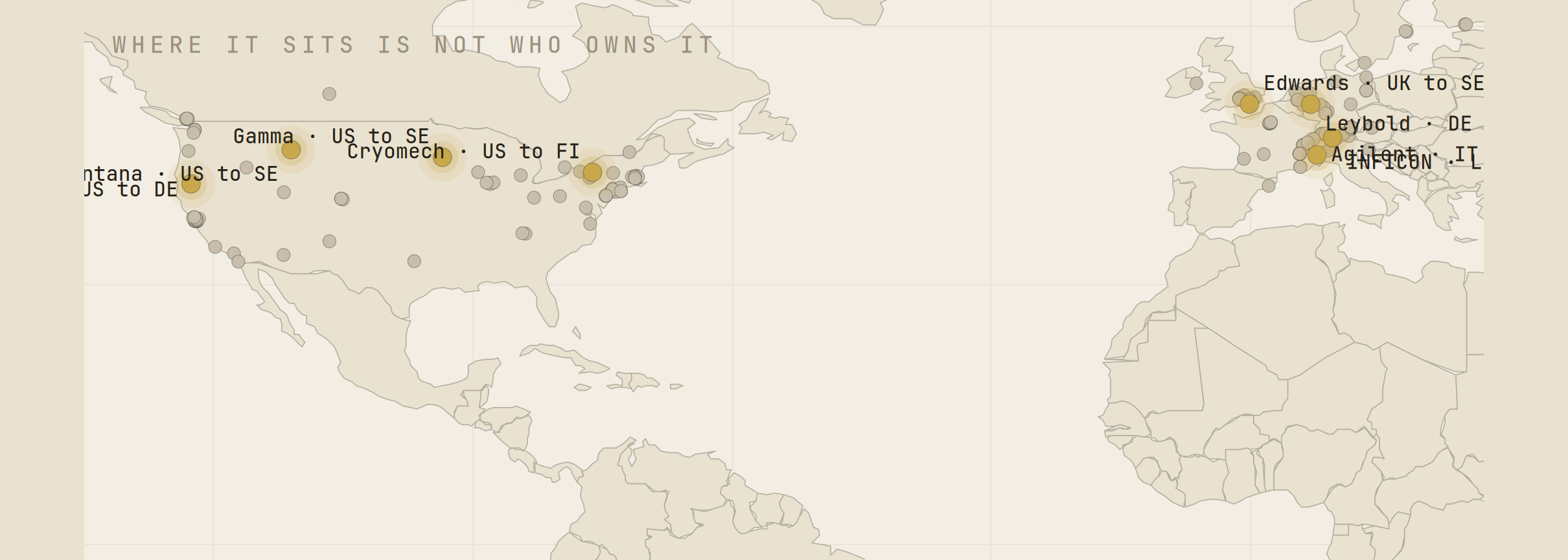
The flag on the pin is rarely the flag that owns it. Edwards (England) is controlled from Sweden by Atlas Copco, as are Leybold (Germany) and Gamma Vacuum and Montana Instruments (United States). Nor-Cal (California) is controlled from Germany, through Pfeiffer and Busch. Cryomech (New York) is controlled from Finland, through Bluefors, which acquired it. When I recolor the map by who controls each actor instead of by where it stands, the picture rearranges. Location and ownership give two different maps. Most readers use the location map. The ownership map decides what happens when a border closes.
A further shift is under way. The hardware that holds the vacuum is made across a scatter of small countries, each a national monopoly in one narrow thing, Dutch light, German and Swedish pumps, Swiss valves, Italian getters, Austrian metals, French helium. That sovereignty is physical and hard to move, and the value is leaving it. The layer that is starting to matter sits above the pump: the data coming off it, the predictive service, the telemetry, the model that warns a fab a pump will fail before it does. That layer is sold by the equipment vendors themselves. Edwards sells a Semiconductor Intelligent Service, and Applied Materials and Lam Research sell equipment-analytics platforms. All of them run on external cloud infrastructure, on American clouds, a dependence one layer further up. None of the countries that make the hardware hosts that layer.

I can read these patterns in the vacuum chain because I drew that chain by hand, node by node, from the acquirers’ own announcements, cross-checked against each company’s corporate and investor pages, and joined each actor to its owner and its sector. Every position, sector and control coding on the map comes from that work, and the Actors map carries it as its actor-control layer.
Under this map sits a floor of its own, the vacuum beneath the fabs. The map itself is the world map, actor by actor.
Sources · 4
- Ownership and consolidation, drawn from the acquirers' own announcements: Atlas Copco's acquisitions of Edwards, Leybold, Gamma Vacuum and Montana Instruments; Busch Group's ownership of Pfeiffer Vacuum; Pfeiffer's acquisition of Nor-Cal Products; Bluefors' acquisition of Cryomech. Cross-checked against each company's corporate and investor pages.
- Chokepoint positions, from company disclosures and standard semiconductor supply-chain reporting: ASML as sole EUV lithography supplier; Lasertec as the only commercial actinic patterned-mask inspection tool for EUV; VAT in ultra-high-vacuum gate valves; SAES in getters; Plansee in refractory metals; DISCO in wafer dicing and grinding; the large cryoplant duopoly of Air Liquide and Linde Kryotechnik, the Swiss cryoplant arm of Linde; TSMC at over 90 percent of leading-edge logic.
- The value migrating to a data layer above the hardware: the predictive and telemetry services now sold by the equipment vendors themselves, including Edwards' Semiconductor Intelligent Service, Applied Materials' and Lam Research's equipment-analytics platforms, all running on external cloud infrastructure.
- Actor positions, sectors and control coding: the Mean Free Path Actors map and its actor-control layer, a hand-built synthesis of the above, joined actor by actor.
Ratings follow the Stack scale: [A] primary or standard, [B] manufacturer, [C] secondary.