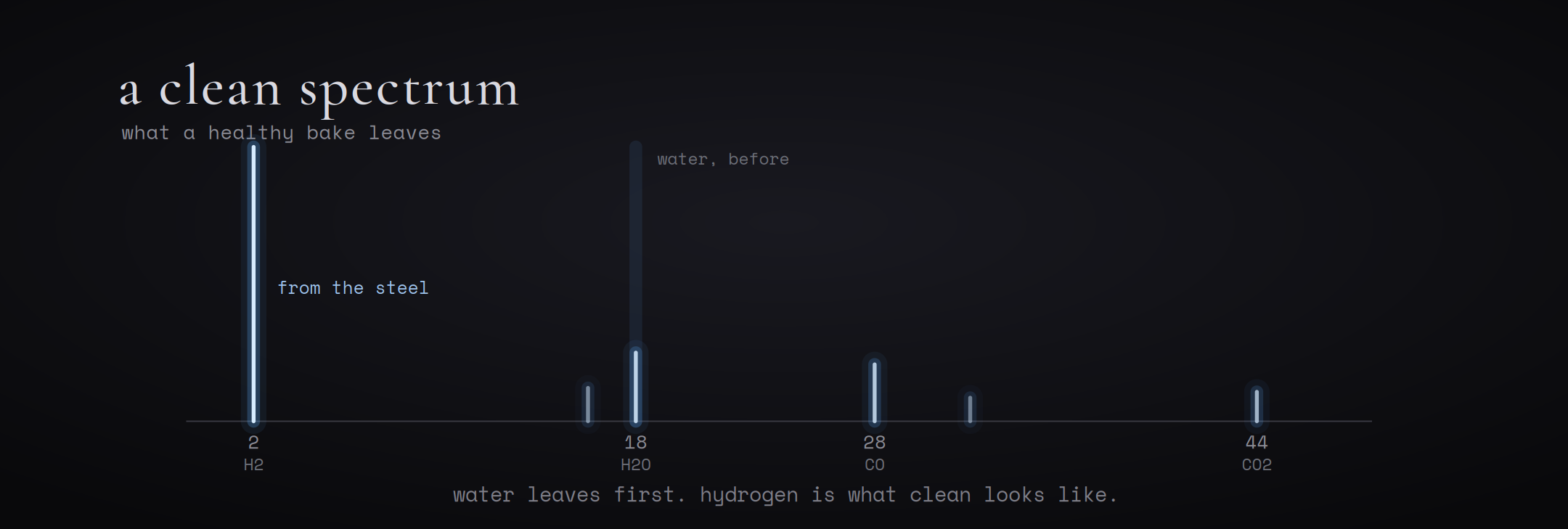
There is a screen in our bake area that I built. It shows nine stations at once: total pressures, wall temperatures, the slow climb of a residual gas spectrum as a chamber gives up its water. I wrote every line of it. On a good week it tells me at a glance the health of a fleet I once had to walk to, controller by controller.
And it does not make a single pump pump faster.
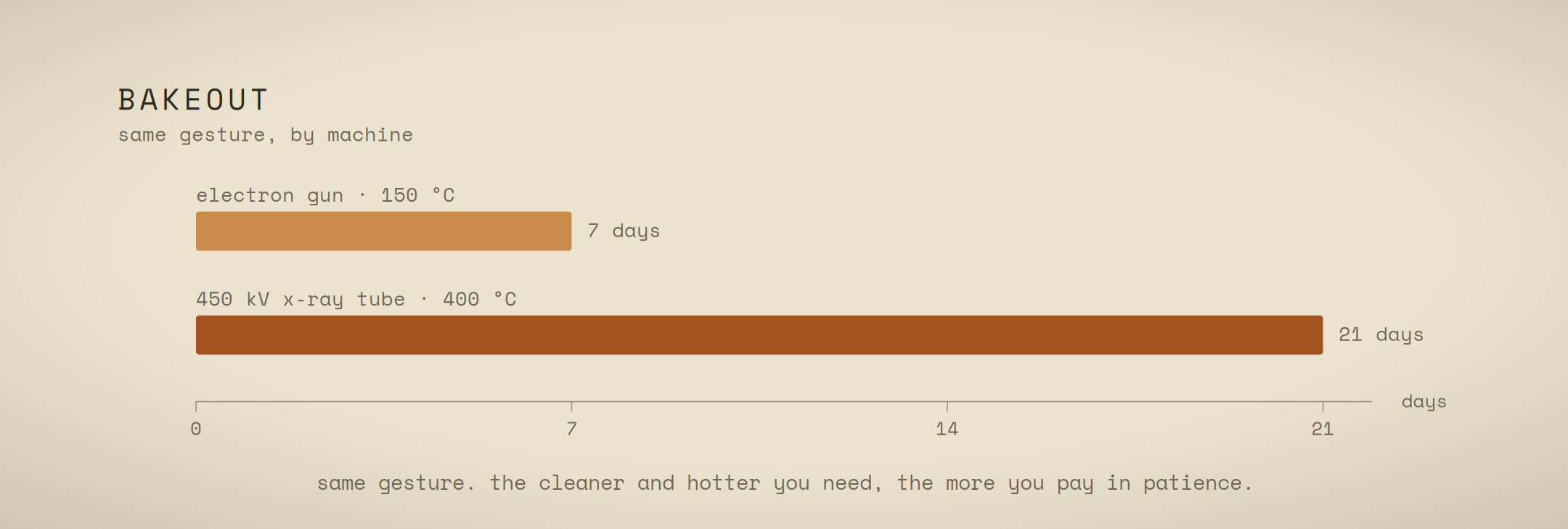
The trade keeps a bright promise about screens like mine. Connect the pumps, gather the data, and the vacuum becomes a thing you can predict, manage, stay ahead of. The promise is not empty, and the people selling it are very good at what they do. The bake takes what it takes: about a week at 150 °C on our electron gun, three weeks above 400 °C on an earlier 450 kV X-ray tube. The screen watches the water come off the walls and has no effect on its rate. No measurement I have ever taken has shortened a pumpdown by an hour.
The reason the promise sells anyway is arithmetic, and the arithmetic is real. In a leading-edge fab a pump that dies unannounced can scrap a hundred wafers and cost into the millions of dollars a year, so the largest pump makers have turned decades of telemetry into models that call a failure before it lands, and the largest toolmakers wire tens of thousands of chambers into a single screen. At that scale an hour of warning is worth a fortune. The economics are sound. The error lies in what we let ourselves believe fleet data can predict.
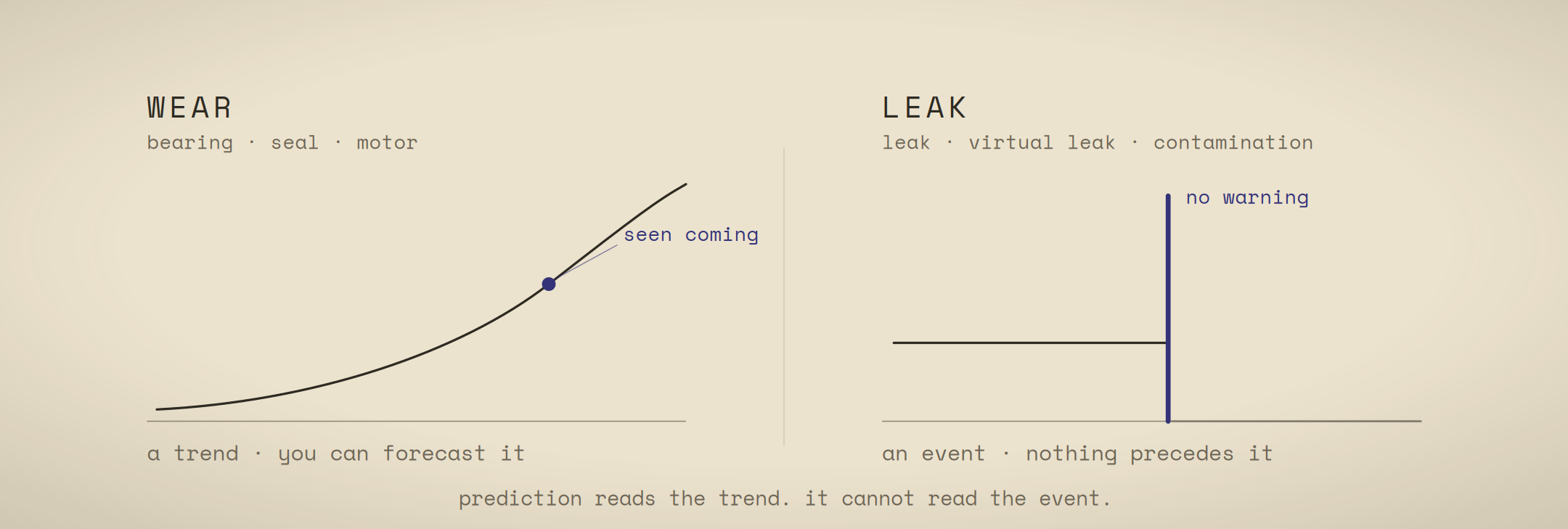
Prediction works on a pump. Bearings wear, seals harden, a motor draws a little more current each month. That is a trend, and a trend can be foreseen. The failures that actually ruin a vacuum are events: a leak, a virtual leak trapped behind a blind weld, a surface that went dirty. No history tells you the hour a weld will begin to weep. The screen cannot see them coming, because there is nothing, yet, to see. On an event, what the screen adds is a faster alarm and a better autopsy.
What the screen provides is memory: a stored record of how a healthy pumpdown behaves.
For years the knowledge of what a healthy pumpdown looks like lived in a few people’s hands. The shape the curve should take. The pressure that ought to have fallen by Thursday and did not. The particular wrongness of a bad bake, felt long before any number confirmed it. That knowledge carried the process, and it left the room when the people did. A retirement, a transfer, and a fleet forgets how it is supposed to behave.
The screen writes the operator down. It takes an intuition that lived in one head and turns it into a curve the next person inherits. The generation before mine automated the gesture: the valve, the interlock, the sequence that used to be a hand on a knob. My generation documents the gesture, at the scale of a fleet, so it can be compared, audited, and remembered. This is a narrower claim than the vendors’ promise.
There is one place where this stops being a convenience and becomes a law of the building. In a fusion reactor, once the machine is running, no human will enter it again. The walls are activated, the fuel is deuterium and tritium, and the inside becomes a room no person can walk into. The vacuum system there is large, hundreds of pumps and some 10 km of line, watched without pause by software. That watching is there because there is no one to send. The exact move I make on a screen for nine bake stations, a reactor is forced to make for a machine no one can ever touch again. The scale differs enormously, and the function is the same.
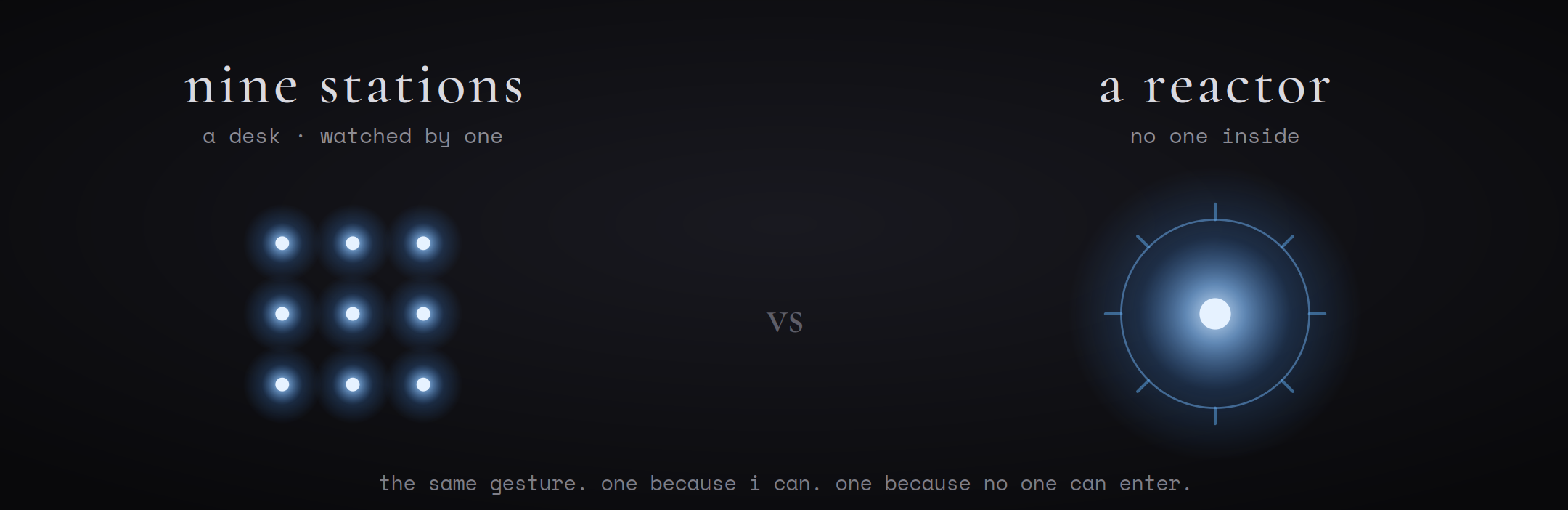
Anywhere the people who can read a process by feel will one day leave the room, the instrument that wrote down what they knew is the only thing that stays. The dashboard keeps the process knowledge after the operator leaves.
The screen is worth building, and I have given mine years. It records and compares pumpdowns. The bake time is still set by the water leaving the walls.
Sources · 5
- Outgassing as the rate-limiting load in ultra-high vacuum, water as the dominant species at room temperature, and the bakeout that drives it off: O'Hanlon, A User's Guide to Vacuum Technology (Wiley); Redhead, Hobson & Kornelsen, The Physical Basis of Ultrahigh Vacuum.
- Predictive maintenance on semiconductor vacuum pumps, the cost of an unplanned pump failure in a fab, and fleet-scale models trained on pump telemetry: Edwards Vacuum, Semiconductor Intelligent Service and predictive-maintenance case material; vacuum-pump predictive-maintenance papers in the SEMI Advanced Semiconductor Manufacturing Conference proceedings.
- Tens of thousands of process chambers connected to a single analytics platform for diagnostics and predictive maintenance: Applied Materials AIx platform disclosures; Lam Research Equipment Intelligence.
- Forecastable wear versus discrete failure events, the leak, the virtual leak, and surface contamination: O'Hanlon, A User's Guide to Vacuum Technology (Wiley).
- The ITER vacuum system, the inaccessibility of the activated, tritium-fuelled machine in operation, and the resulting reliance on remote monitoring and handling: ITER Organization vacuum-system and remote-handling descriptions; ITER Vacuum Handbook.
Ratings follow the Stack scale: [A] primary or standard, [B] manufacturer, [C] secondary.