
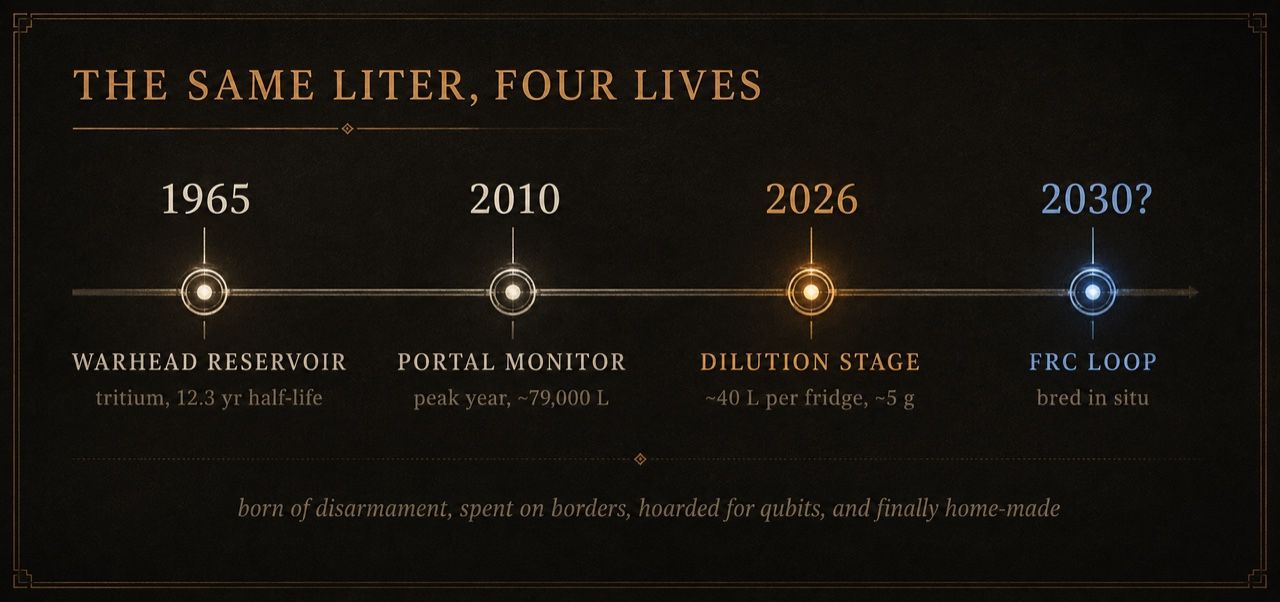
The coldest object in most buildings that own one hangs from the ceiling like a chandelier: gold-plated discs stacked by diameter, coaxial lines falling between them like vines, and at the bottom, colder than interstellar space, a stage a few centimeters across where the qubits live. The working fluid of that last stage is helium-3. A large dilution refrigerator carries a charge of roughly forty liters of the gas. At standard conditions that is about five grams of matter, the mass of a sheet of paper, and at current purified prices it is a six-figure sum. The machine circulates the same charge, year after year, through a sealed loop of pumps, traps, and heat exchangers.
Every gram of it began life inside a nuclear weapon.
Modern warheads are boosted with tritium, and tritium decays with a half-life of 12.3 years, so the reservoirs come back on a schedule to be purged and refilled. The gas skimmed off during that maintenance, at the Savannah River Site, is decayed tritium: helium-3. It is the only domestic source the United States has ever had, auctioned in small lots through the federal isotope program. The deterrent pays out a dividend, a few thousand liters a year, and the supply chain of the coldest machines starts there.
The vacuum hardware stays in the background of this essay. The link to this site is the gas itself. Helium is my trade’s own gas: every weld I have ever qualified was sprayed with it, every leak I have ever found announced itself as mass 3 or 4 on a spectrum. The machines that drink this isotope are cryogenic ultrahigh-vacuum systems built by people I would recognize at a conference. And the story that follows is, from its first liter to its last, a story about closed systems. Those are the only stories I know how to read properly, so I am going to read this one.
the gas nobody makes
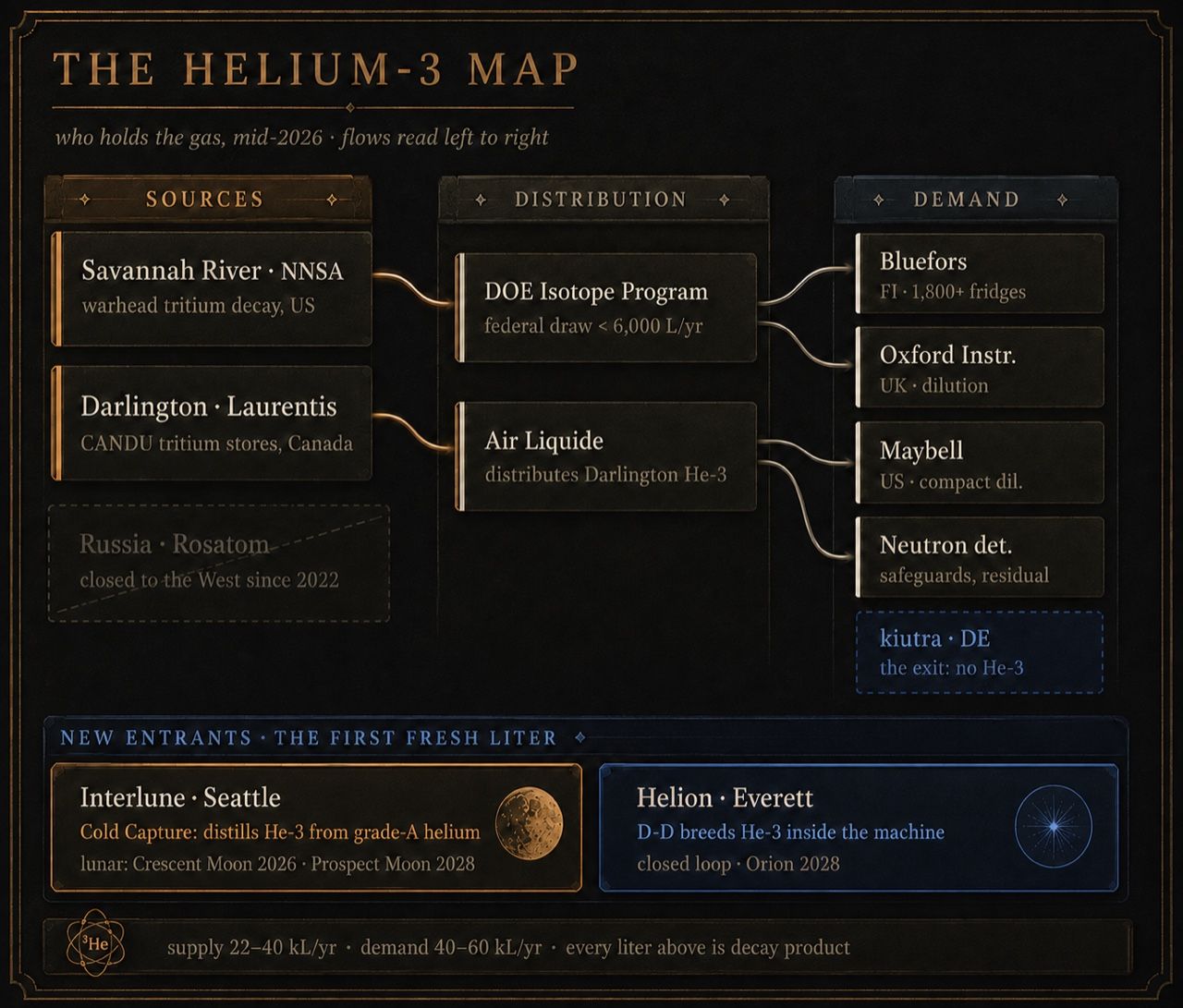
Helium-3 is harvested from tritium decay, and the harvest is small. On the supply side of the ledger there are exactly three working entries. The American one: warhead maintenance at Savannah River, federal draw now held under six thousand liters a year after the rationing reforms. The Canadian one: Ontario’s CANDU reactors produce tritium as a byproduct of heavy-water operation, and Darlington holds one of the largest civilian tritium inventories on Earth. Laurentis, an Ontario Power Generation subsidiary, extracts the helium-3 that accumulates in the storage containers, and Air Liquide distributes it. The Russian one: real, and since 2022 effectively closed to Western buyers.
Add it up and the world produces somewhere between twenty-two and forty thousand liters a year, depending on whose survey you trust, against demand estimates of forty to sixty thousand. The American stockpile sat near ninety thousand liters at last public count, roughly double its level at the bottom of the 2010 crisis. The supply curve is a radioactive decay law applied to a warhead inventory whose size is set by arms-control treaties. Disarmament is the upstream industry. Every liter in every fridge is the deterrent’s exhaust, metered by a half-life nobody can negotiate with.
the year the gas ran out
We have run this experiment before. After 2001, the United States decided to scan cargo at its borders for smuggled nuclear material, and the neutron detector of choice was a helium-3 proportional counter. The build-out consumed the gas at a rate that peaked near seventy-nine thousand liters in a single year, emptied most of the strategic stockpile, and forced a secret interagency rationing scheme before Congress ever heard the isotope’s name. The GAO wrote the postmortem in 2011.
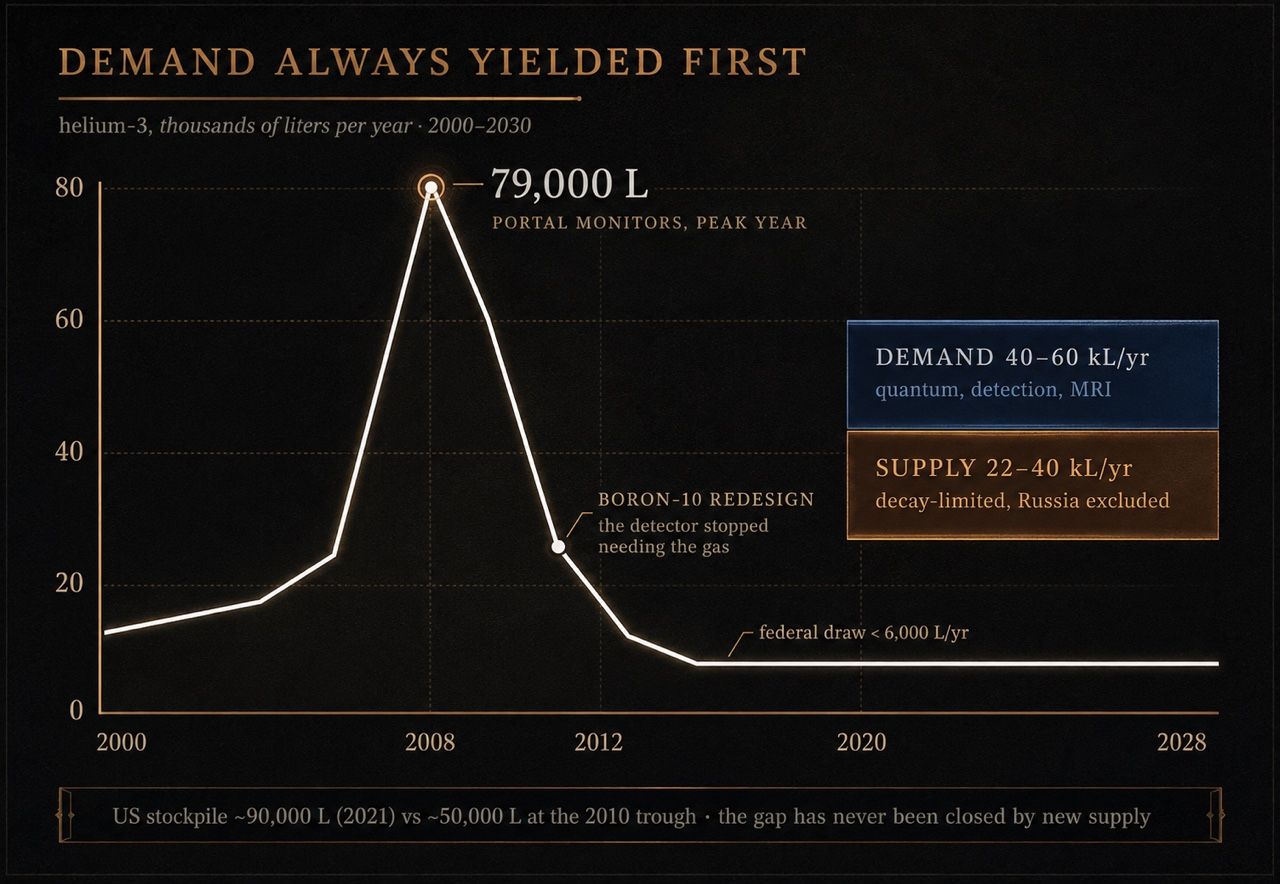
No new source appeared. The largest helium-3 consumer on Earth redesigned its detectors around boron-10 lined tubes and stopped needing the gas at all. Federal demand collapsed by an order of magnitude and the stockpile began, slowly, to refill.
In the recorded history of helium-3, demand has adjusted to supply, as it did after the portal-monitor peak of 2008.
arithmetic at the bottom of the tank
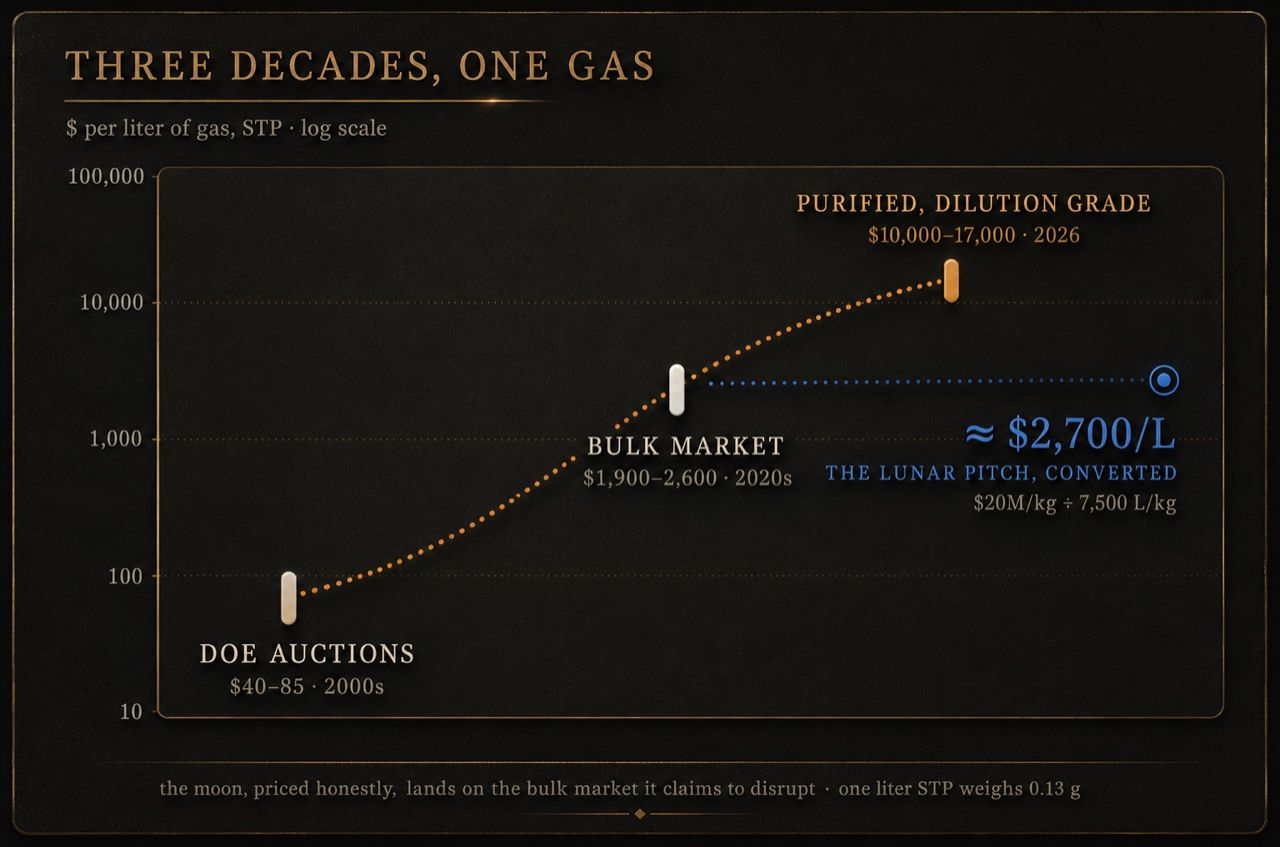
The forecasts now circulating for the quantum era do not survive their own units, and the failure is instructive. Helium-3 quantities arrive in liters of gas, liters of liquid, grams, and kilograms, often in the same paragraph, and the conversions are brutal: one liter of gas at standard conditions weighs 0.13 grams, so a kilogram is about seven and a half thousand liters. The headline figures of three to four hundred kilograms of annual quantum demand convert to two or three million liters, which at roughly forty liters per large machine means tens of thousands of new dilution refrigerators built every single year. The market’s own per-machine gram counts put it near eighty thousand. The installed base, accumulated over two decades, is a few thousand. The largest manufacturer claims some eighteen hundred systems deployed, total.
The price record tells the same story in dollars. Federal auctions in the 2000s cleared at forty to eighty-five dollars a liter. The bulk market of the 2020s runs one thousand nine hundred to two thousand six hundred. Purified to dilution grade, above ten thousand, at times nearer twenty. Three decades of price climbed in twenty years. The lunar-mining pitch quotes helium-3 at twenty million dollars a kilogram. Divided by seven and a half thousand liters, that is about two thousand seven hundred dollars a liter, squarely on the bulk market it claims to disrupt.
a stock, filled once
There is a deeper error under the arithmetic, and it takes a practitioner to feel it in the hands. A dilution refrigerator does not consume helium-3. It seals it. The charge is an inventory, circulating in a closed gas-handling system where recovery is a religion and venting a six-figure accident. Losses exist, through permeation, through cold-trap maintenance, through the occasional human mistake, and they are small in a well-run circuit. Demand from quantum computing is therefore a stock: filled once per machine, topped up against losses, returned when the machine retires. Each machine is filled once, and the forecasts price that fill as an annual flow.
That distinction rewrites the market. Stock demand scales with the number of machines built, and machines are built slowly. It also means the existing fleet is a reservoir: eighteen hundred fridges at up to forty liters apiece is on the order of seventy thousand liters already above ground, sealed, recoverable, and eventually resalable. Anyone who has chased leaks for a living reads the forecasts and sees the confusion at a glance, because our whole trade is the discipline of keeping a stock from becoming a flow.
three claimants to the first fresh liter
For the first time in the isotope’s history, three different industries claim they are about to make new helium-3. Until now all of it has been harvested from tritium decay.
The first claimant is the Moon. Interlune, a Seattle company founded by lunar-industry veterans, has assembled about half a billion dollars in agreements, including a deal with the largest fridge maker for up to ten thousand liters a year across 2028 to 2037, and a camera riding to the lunar surface late this year to measure regolith concentrations, ahead of an excavation payload NASA has funded toward readiness in 2027. Interlune is no longer alone: in early August a second lunar company, Black Moon Energy, signed a prospective helium-3 supply agreement with the fusion firm TAE Technologies, a robotic survey mission promised within five years. I will offer a dated bet on all of it below. Their own disclosures set the first deliveries on terrestrial sources. Interlune’s Cold Capture program distills helium-3 out of ordinary Grade-A helium at liquefaction plants, hit ninety-nine percent purity this summer, and carries a defense contract to industrialize. The company sells the Moon and ships from a distillery, and the distillery is the better business. Prospectors have taken the hint: a Minnesota helium well spent the winter reporting the richest helium-3 concentration yet published for a terrestrial gas reservoir, about a dozen parts per billion, federally verified, and still, at heart, a feedstock for the same distillation.
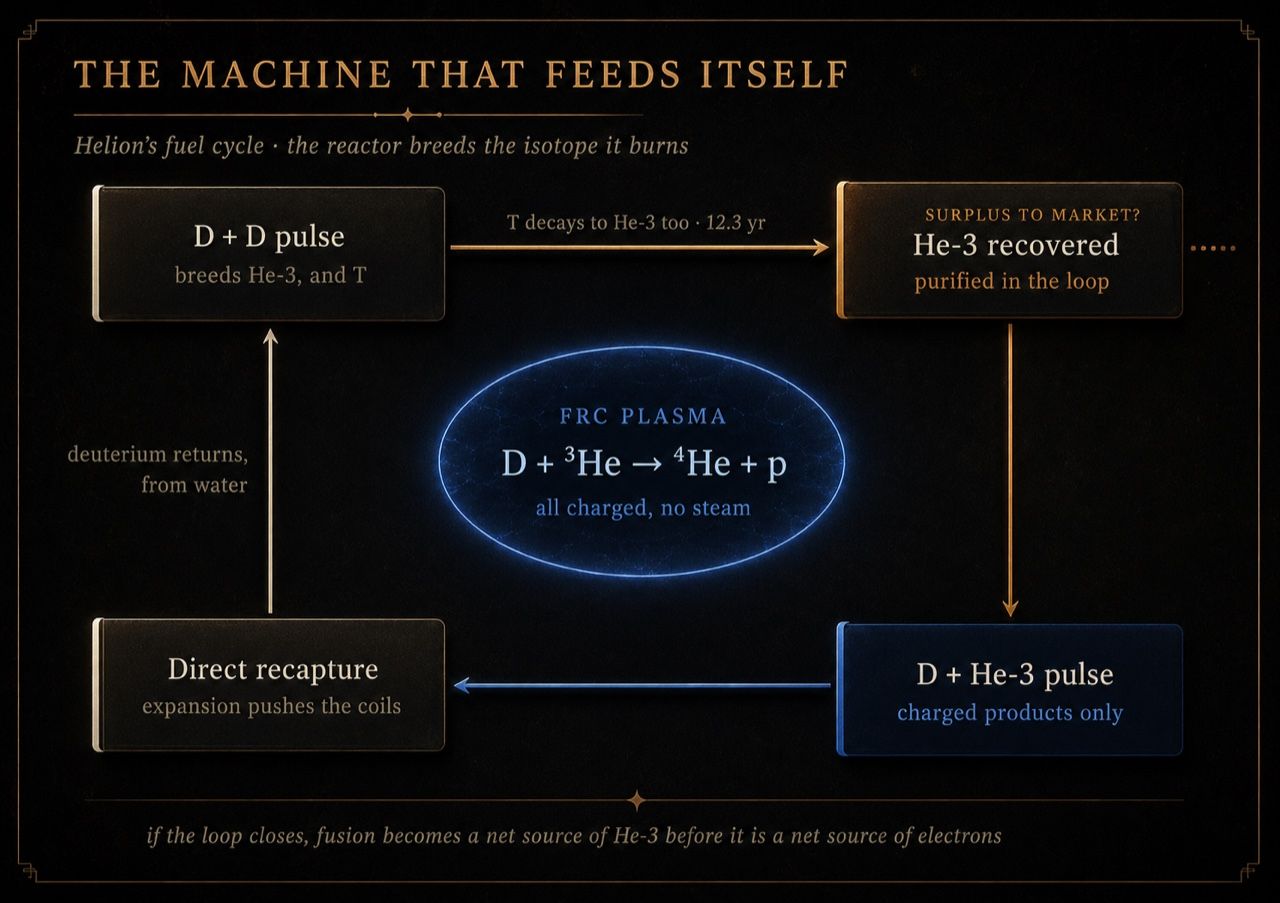
The second claimant is fusion. Helion’s reactors are designed to burn deuterium and helium-3, a reaction whose products are all charged, which is what lets them pull electricity straight off the expanding plasma instead of boiling water. The fuel problem solves itself in the loop: the deuterium-deuterium side reactions breed helium-3, directly and through tritium that decays into more of it, and the company recovers and purifies the isotope in-house. Their founder has said they make it efficiently enough to consider selling the surplus. Their first commercial plant is under construction against a 2028 delivery contract. If the loop closes, fusion becomes a net source of helium-3 before it becomes a net source of electrons.
The third claimant removes the need for the gas. A Munich company sells millikelvin cooling with no helium-3 at all, adiabatic demagnetization instead of dilution, and openly doubts that an industry should be built on this gas. If quantum hardware ever standardizes around such platforms, the story ends the way 2010 ended: the detector redesigned, the gas unneeded. That history says to take that possibility more seriously than any supply forecast.
the sting
In March, while I was writing this, strikes on Qatar’s Ras Laffan complex put roughly a third of the world’s helium supply under force majeure, with repairs measured in years. Russia, the swing producer, has its helium under export controls into late 2027. Spot prices doubled. Ordinary helium-4, the abundant isotope, the gas we spray on welds without thinking, became the most contested molecule in the industrial gas trade. The most credible new source of helium-3 is a distillation column bolted to that same helium-4 liquefaction stream, which became supply-constrained in March. Every working helium-3 source depends on another resource: warhead tritium decay, CANDU operation or the helium-4 liquefaction stream.

points of rendezvous
Dates this essay can be checked against:
- Late 2026. Interlune’s Crescent Moon camera flies on Astrobotic’s Griffin-1 lander.
- Fall 2027. The Prospect Moon excavation payload is due ready for lander integration, for a launch in 2028.
- End 2027. Russia’s helium export controls expire, or are renewed.
- 2028. Helion’s Orion plant faces its Microsoft delivery deadline. First Interlune deliveries to Bluefors come due.
- 2029 to 2031. Ras Laffan’s helium capacity is due back, on the announced repair horizon.
four bets
Falsifiable, dated, and signed:
- B1. On January 1, 2030, more than ninety percent of commercially sold helium-3 will still trace to tritium decay, arsenals plus CANDU, and zero lunar liters will have been delivered to any customer.
- B2. The first new source to ship meaningful volume, say a thousand liters in a year, will be terrestrial distillation of the helium stream. The Moon will not be first, on any timeline I would sign.
- B3. If Orion runs on deuterium and helium-3 by its 2028 commitment, Helion will sell surplus helium-3 commercially before it has sold a full year of contracted electricity.
- B4. Real quantum-driven demand stays below ten thousand liters a year through 2030, an order of magnitude under the headline forecasts, because the machine fills a stock and the forecasts price a flow.
the six taps
| tap | mechanism | status 2026 | scale |
|---|---|---|---|
| Savannah River, US | warhead tritium decay | operating, sole US source | few kL/yr |
| Darlington, Canada | CANDU tritium stores, via Laurentis and Air Liquide | operating | few kL/yr |
| Russia | tritium decay, Rosatom | closed to Western buyers since 2022 | opaque |
| Terrestrial distillation | He-3 skimmed from Grade-A helium (Interlune Cold Capture) | 99 % purity shown, industrializing | claimed: could triple US supply |
| Lunar regolith | solar-wind He-3 mined from the Moon | camera flies late 2026 | promised, 2028 onward |
| Fusion breeding | D-D side reactions in-loop (Helion) | Polaris operating, Orion building | surplus offered, unquantified |
Sources · 17
- Helium-3 as a warhead byproduct, Savannah River the sole US source, and the federal draw held under 6,000 liters a year after the mitigation reforms: DOE Isotope Program, National Isotope Development Center, Supply and Demand of Helium-3.
- The 2008 to 2011 shortage and the boron-10 detector redesign that ended it: US GAO, Neutron Detectors, Alternatives to Using Helium-3, GAO-11-753 (September 2011).
- The DOE isotope-management postmortem, the historical auction price of 40 to 85 dollars a liter, and the allocation and pricing tables: US GAO, Managing Critical Isotopes, GAO-11-472 (May 2011).
- Demand history from about 8,000 liters a year before 2001 to about 80,000 liters in 2008, the stockpile falling from 235,000 liters (2001) to 50,000 liters (2010), Ontario Power Generation tritium yielding roughly 130,000 liters of helium-3 over ten years, and the near-lossless reuse of a charge: Shea and Morgan, The Helium-3 Shortage: Supply, Demand, and Options for Congress, CRS R41419 (October 2011).
- The US stockpile near 90,000 liters per a 2021 DOE document, and Regnat of kiutra on dilution as an industrial base: Savitsky, As helium-3 runs scarce, researchers seek new ways to chill quantum computers, Science (AAAS).
- Darlington tritium stores, Laurentis extraction, and Air Liquide purification and distribution as the first non-military source: Laurentis Energy Partners and Air Liquide press releases (December 2021).
- The XLD1000sl helium-3 charge at an optimal ratio of 40 liters helium-3 to 180 liters helium-4, and a dilution-refrigerator base temperature below 10 mK: Bluefors, Dilution Refrigerator Measurement Systems product documentation.
- The bulk market at 1,900 to 2,600 dollars a liter, purified dilution grade above 10,000, the roughly six-figure charge, the unit conversions, an installed base above 1,800 systems, and a structural deficit of 20,000 to 40,000 liters a year: PostQuantum, Helium-3 in Quantum Computing, and Quantum Cryogenic Infrastructure and Helium-3 (May 2026).
- The roughly 79,000-liter peak-year framing, the demand-side reading of GAO-11-753, and world production near 40,000 liters a year from USGS-derived figures: PostQuantum, Helium-3 Alternatives for Quantum Computing, Assessed (June 2026).
- Interlune Cold Capture at 99 percent purity from Grade-A helium, an AFWERX SBIR Direct-to-Phase-II award (November 2025), nearly 500 million dollars in binding purchase agreements led by Maybell Quantum and Bluefors, and the claim of tripling US supply: Interlune press release (July 20, 2026).
- The Bluefors purchase of up to 10,000 liters a year, with deliveries across 2028 to 2037: Bluefors and Interlune press release (September 16, 2025).
- The NASA SBIR Phase III award of 6.9 million dollars for the Prospect Moon extraction payload, the Crescent Moon camera on Astrolab's FLIP rover aboard Astrobotic's Griffin-1 in late 2026, roughly 500 million dollars in contracts including DOE, and first shipments likely terrestrial via Cold Capture: SpaceNews (May 2026) and GeekWire (July 2026).
- The Interlune payload ready for launch in 2028 under the same NASA SBIR Phase III contract: Interlune press release (May 4, 2026).
- The Helion fuel loop breeding helium-3 from deuterium side reactions and reusing it in-house at high efficiency, Kirtley open to selling surplus, Polaris running deuterium-tritium at 150 million degrees, and Orion at 50 megawatts under construction for the 2028 Microsoft commitment: TechCrunch (February 13, 2026) and POWER Magazine (February 2026).
- The March 2026 Ras Laffan strikes removing roughly a third of world helium supply under force majeure, a three-to-five-year repair horizon, Russian helium export controls running to end-2027, and doubled spot prices: gasworld (April 2026), WestAir (June 2026), and The Moscow Times (April 14, 2026).
- The TAE and Black Moon Energy prospective helium-3 supply and commercialization agreement, and BMEC's robotic lunar delineation mission within five years: TAE Technologies press release (August 5, 2026).
- Helium-3 at 11.2 to 11.9 parts per billion in raw gas at the Topaz project, Minnesota, verified by the USGS Noble Gas Laboratory and Lawrence Livermore National Laboratory: Pulsar Helium news release (January 19, 2026).
Ratings follow the Stack scale: [A] primary or standard, [B] manufacturer, [C] secondary. Links verified August 2026.