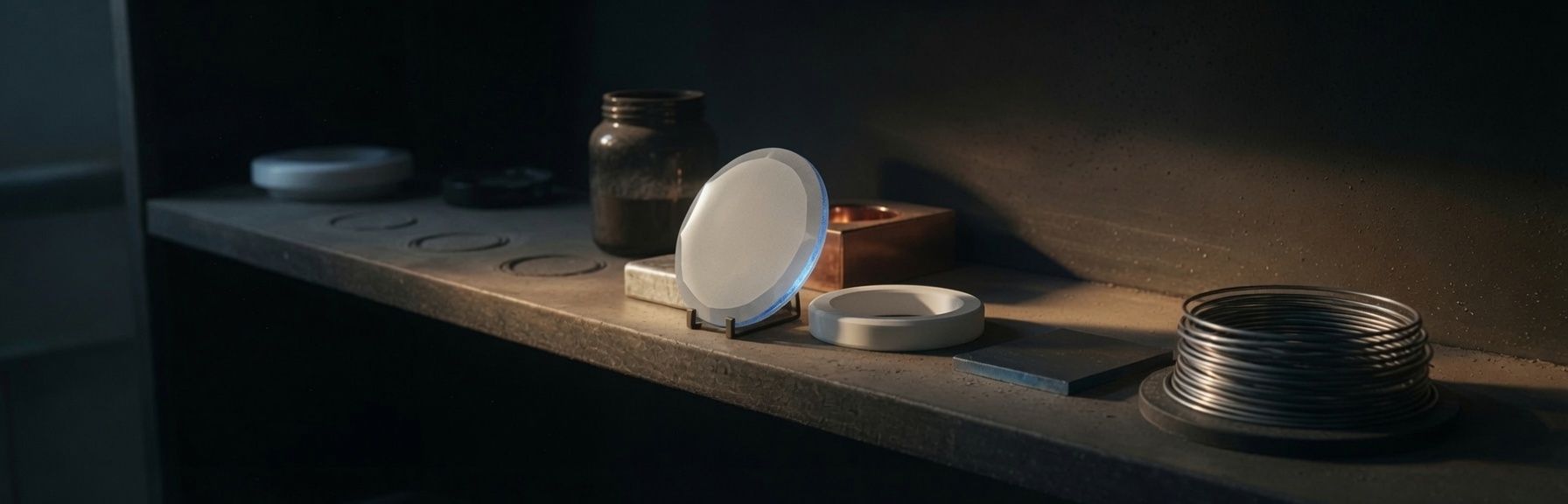
Take the parts list of a radar magnetron, any of them, drawn around 1955. Read it against the three shelves of The Matter, workhorse, banned, future, and stamp each line with where its material stands in 2026.
Anode block, oxygen-free copper: workhorse. Cathode, barium and strontium oxides on a nickel sleeve: workhorse, with an asterisk this essay will spend. Heater, tungsten: workhorse, export-licensed since February 2025. End shields, molybdenum: workhorse, licensed under the same decree. Magnet, Alnico, cobalt-rich: workhorse, the cobalt carrying a carcinogen classification since 2021. Seal rings, Kovar, seventeen percent cobalt: same element, same file. Braze on the cooling fittings, silver alloy, cadmium-bearing: banned since 2011. Process sheet, step one, vapor degrease in trichloroethylene: authorization holders only since 2016. Step four, chromic bright dip: authorization holders only since 2017.
I have held drawings like this at the bench, in a French tube house older than the transistor, and read the margin notes the way you read the menu of a restaurant that has closed. The parts list is unchanged, and the status of most of its materials has moved.
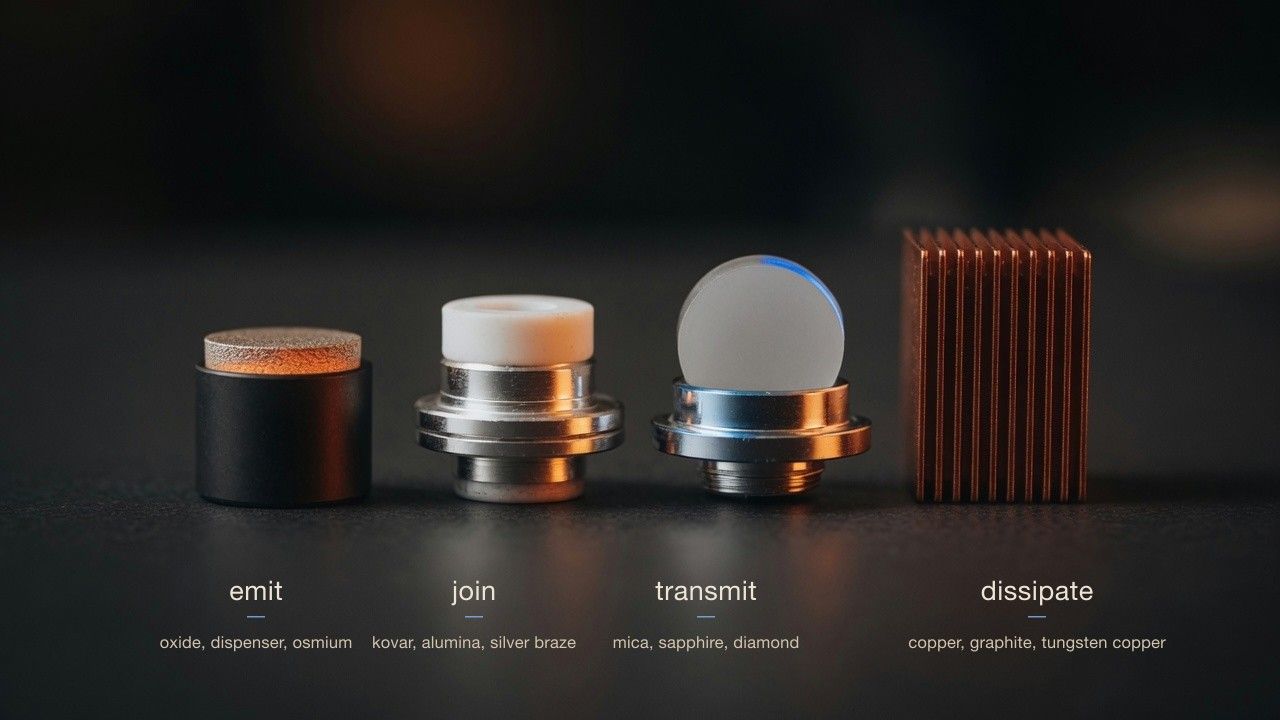
The functions of a tube have held still since Fleming: emit electrons, hold vacuum and join dissimilar parts, let the power out through a window, dump the heat that remains. Everything else rotated, and for a hundred years the rotation ran in one direction: more elements, more recipes, more of the periodic table conscripted each decade.
Emission first. Wehnelt showed in 1904 that barium and strontium oxides emit at a fraction of tungsten’s temperature. Coolidge made tungsten ductile in 1909, and by 1911 the industry had abandoned every rival filament process. Thoriated tungsten entered production tubes in 1925, with emission up to fifty times that of the bare metal. The 1950s brought the dispenser cathode, barium chemistry stored in a porous tungsten plug, and its M-type refinement still wears a sputtered film of osmium and ruthenium: a coating drawn from a metal produced at well under a tonne a year, worldwide, applied to the most consumable component in the device.
Joining next. Glass met metal through Dumet wire, then through Kovar in the 1930s, an iron-nickel alloy holding seventeen percent cobalt so its expansion tracks hard glass. The 1950s added molybdenum-manganese metallization, which let alumina take over from glass as the envelope, and silver-copper brazes to close the joints. Windows ran from mica to glass to beryllium for X-rays, to beryllium oxide where the heat climbed, to sapphire, and finally to diamond. Heat went into oxygen-free copper, pyrolytic graphite, tungsten-copper.
None of it was rationed. Kohl’s 1967 handbook and Rosebury’s 1965 shop manual read today like the inventory of an unlocked building: thorium in the cathode chapter, mercury in the pumps, cadmium at the braze bench, trichloroethylene in every cleaning sequence, chromic acid at the bright dip. Rosebury alone lists page after page of preparations that a European shop can no longer run in 2026 without an authorization file. Both books were written as references. They have aged into records.
Regulation closed the shelf first, and it closed it politely. Cadmium left the braze bench in 2011, when Europe capped it at a hundredth of a percent in filler metals. Trichloroethylene reached its sunset in April 2016. A solvent that moved fifty thousand tonnes a year through European industry in 2010 moves about twelve hundred today, a collapse of ninety-five percent inside a decade, and the survivors operate under individual authorizations with expiry dates. Chromic acid followed in September 2017. Cobalt, seventeen percent of every Kovar ring, has carried a European classification as a category 1B carcinogen since 2021: the sealed part is untouched, the powder, the grinding dust and the braze fume are another matter, and the exposure limits keep descending. Beryllium stayed legal and lost a factor of ten off its American workplace limit in 2017. Thorium retreats under radioactive-materials rules. Lead survives in tube glass on a lease: the RoHS exemption that covers it was restructured in 2025 and now expires in mid-2027 unless renewed. Each restriction is individually manageable, and together they change what a tube shop can run.
Supply closed faster, and with dates attached. On December 3, 2024, China prohibited, in principle, the export of gallium, germanium, antimony and superhard materials to the United States, and barred dual-use items to American military users outright. Eleven months later the materials clause was suspended, as part of a trade truce, until November 27, 2026. The military clause stayed. Access now comes with a printed expiration date. On February 4, 2025, a second decree placed tungsten, tellurium, bismuth, molybdenum and indium under export licenses: the two framework metals of the tube, the heater wire and the end shield, in one document. The regime held through the truce and tightened in January 2026, when tungsten exports were centralized on fifteen designated companies and ammonium paratungstate crossed eleven hundred dollars per metric ton unit, roughly triple its level two years earlier. The United States has mined no tungsten since 2015. China holds about eighty percent of world supply. Behind the framework metals stand the trace ones. Rhenium, the heater alloy’s stiffener, amounts to eighty-one tonnes a year worldwide, and superalloy turbine blades take eighty percent of it before a tube shop sees a spool. Osmium, sputtered onto every M-type cathode, is produced at well under a tonne a year. Scandium, carrier of the scandate cathode that has been the future for fifty years, runs near forty tonnes a year with no primary mine on Earth and a license regime on the largest producer.
The third closure makes no announcements. In 2023, a United States Senate bill proposed restricting traveling-wave-tube sourcing to the national technology and industrial base. The provision was not adopted, and the fact that someone drafted it says enough about how thin the base had become. Space-qualified traveling-wave tubes come, for the most part, from two Western houses. Below the companies sit the hands. Ceramic-to-metal brazing, cathode impregnation, glass lathe work: these are taught at the bench, over years, by people who are retiring faster than they are being replaced. I have stood in shops where one person held the whole braze schedule in their head, and I have watched such a person leave. This closure is recorded only by retirements that outpace hiring.
And yet the future shelf is filling, mostly with returns. Diamond entered a traveling-wave tube in 1988, natural stones standing off a 28 GHz circuit in a NASA program. The device worked and was never replicated, because the stones cost too much. Aluminum nitride now sits where beryllium oxide sat, carrying the heat without the toxicity file. C-103, the niobium alloy of rocket nozzles, arrives on the vacuum bench. Oxygen-free copper returns as powder, printed into monolithic bodies.
The customers are coming back, and they are the largest since radar. ITER’s heating system calls for gyrotrons at 170 GHz delivering a megawatt each, continuously, through diamond. The machines being drawn behind it ask for multi-frequency sources at 136, 170, 204 and 238 GHz. Private fusion companies are ordering from the same short list of gyrotron houses. EUV lithography runs thirty kilowatts of CO2 laser light through diamond windows on its way to a tin plasma, and every advanced fab on Earth sits downstream of that path. Satellite constellations still fly traveling-wave tubes where efficiency and radiation tolerance rule. The terahertz band waits for vacuum devices because solid state runs out of watts there. Accelerators never left.
All of them arrive at the shelf described above, the one with expiry dates printed on it. So the design logic inverts. For a century, a tube engineer chose the best material and the buyer found a way to pay. The coming decades will run the sequence in the other order: first what is legal, then what is purchasable, then what performs. Call it availability-first design. Three bets follow from it, each with a condition that can prove me wrong.
First, cathodes. The first mainstream tube family to abandon the thermionic dispenser will do it over barium supply and compliance, with lifetime parity still unproven. Watch the launch documents: if the first series tube with a cold or photoemissive source justifies itself on performance while the barium chain stands intact, I lose this one. Horizon 2040.
Second, joints. Printed monolithic bodies will remove most brazed joints from production tubes by 2040. The braze survives at windows and feedthroughs, and the guild shrinks exactly when fusion’s balance of plant starts ordering feedthroughs by the thousand. Count the joints per tube generation in the teardowns and the patents: if the count holds flat through 2040, I lose this one too.
Third, windows. Diamond disk capacity becomes the schedule-limiting item of at least one major electron-cyclotron heating program before 2035. The falsifier is public: a program schedule that slips, with the window supply named, before that date. Absent one, the bet fails.
One more name is moving toward the shelf, and it is already in the roughing pump. The universal PFAS restriction now finishing its scientific evaluation at ECHA covers more than ten thousand substances, fluoropolymers included: the perfluoropolyether oil in the pump, the FKM elastomer in every centering ring. The committees hand their opinions to the Commission around the turn of the year. A decision comes in 2027 at the earliest, application no sooner than 2029, and the industry’s defense has taken the shape of the era: seventy-four derogations, dated.
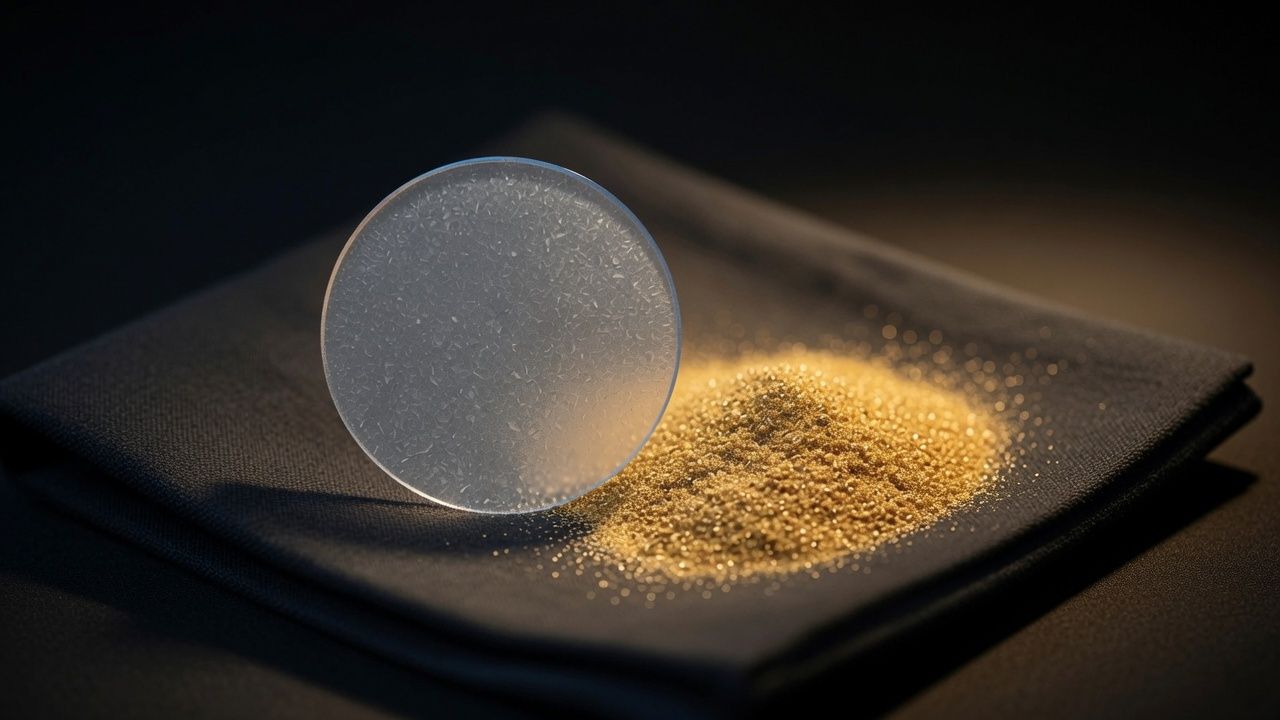
At the top of a fusion gyrotron sits a disc of chemical-vapor-deposited diamond, 119 millimeters across, 2.22 millimeters thick, about 87 grams. It is grown over weeks in a plasma reactor, and a single disc runs into six figures, which puts the gram somewhere an order of magnitude above gold. Match its price in gold and the pile is smaller than you might expect: gold is five and a half times denser than diamond. Every megawatt of electron-cyclotron heating on ITER will pass through carbon like this, because no other window material holds at that power. Ninety grams of carbon now hold the door between a burning plasma and the room.
Sources · 14
- Commission Regulation (EU) No 494/2011, amending REACH Annex XVII entry 23: cadmium restricted to 0.01 percent by weight in brazing fillers, in force late 2011. On the ECHA Authorisation List (REACH Annex XIV), trichloroethylene reached its sunset on 21 April 2016 (EU use fell from about 50,000 tonnes in 2010 to about 1,200, per an ECHA impact case study, 2022); chromium trioxide followed on 21 September 2017.
- Commission Delegated Regulation (EU) 2020/217, the 14th ATP to CLP: cobalt metal classified Carc. 1B, Muta. 2 and Repr. 1B, applicable from 1 October 2021, generic concentration limit 0.1 percent. OSHA final rule, Occupational Exposure to Beryllium, 82 FR 2470, 9 January 2017: permissible exposure limit lowered tenfold to 0.2 micrograms per cubic metre over an 8 hour TWA.
- RoHS Directive 2011/65/EU, Annex III exemption 7(c) (lead in glass and ceramic of electrical and electronic components), restructured by Commission Delegated Directive (EU) 2025/2363 (published 21 November 2025), with revised sub exemptions and expiry dates in 2027.
- MOFCOM Announcement No. 46 of 2024 (3 December 2024): export ban on gallium, germanium, antimony and superhard materials to the United States, and a bar on dual use exports to US military end users; the materials clause was suspended on 9 November 2025 until 27 November 2026, while the military clause remained. MOFCOM Announcement No. 10 of 2025 (4 February 2025): export licensing on tungsten, tellurium, bismuth, molybdenum and indium. In January 2026, tungsten exports were centralised on fifteen designated companies.
- Exiger, Critical Minerals Export Controls: a running tracker of the 2024 to 2026 Chinese measures and their scope.
- USGS Mineral Commodity Summaries, tungsten: no US mine production since 2015, China near 80 percent of world supply. Trade press, January 2026: ammonium paratungstate above 1,100 dollars per metric ton unit, near triple its level two years earlier.
- USGS Mineral Commodity Summaries: rhenium world production 81 tonnes in 2025, a by product of porphyry copper molybdenum roasting, about 80 percent taken by superalloys; osmium reported only within the platinum group, world output well under one tonne a year; scandium near 40 tonnes a year, exclusively a by product, with no primary mine in operation.
- A. Wehnelt reported oxide coated cathodes in 1904 (Annalen der Physik, 4th series, volume 14). W. D. Coolidge made tungsten ductile in 1909, rival filament processes abandoned by 1911, and thoriated tungsten entered production tubes in 1925 (Engineering and Technology History Wiki, Ductile Tungsten). Shop references: W. H. Kohl, Handbook of Materials and Techniques for Vacuum Devices (Reinhold, 1967); F. Rosebury, Handbook of Electron Tube and Vacuum Techniques (Addison Wesley, 1965, AIP reprint 1993).
- Congressional Research Service, Insight IN12221, on FY2024 NDAA defense industrial base provisions: S.2226 Section 835, restricting traveling wave tube sourcing to the national technology and industrial base, was not adopted.
- US patent 6,917,162 (citing NASA CR-182183): a 28 GHz TunneLadder traveling wave tube built with natural diamond supports in 1988, not replicated on cost grounds.
- ITER class electron cyclotron heating uses gyrotrons at 170 GHz, one megawatt continuous, through CVD diamond windows; multi frequency concepts at 136, 170, 204 and 238 GHz are reviewed for machines beyond ITER (EUROfusion DEMO gyrotron review, Fusion Engineering and Design, 2017). Diamond output windows carry megawatt power where sapphire limited near 150 kW, and serve the CO2 laser chain of EUV lithography (Calabazas Creek Research, DOE OSTI 1866817; Element Six).
- Karlsruhe Institute of Technology, step-tunable megawatt gyrotron pre-prototype for DEMO with a diamond Brewster window.
- ECHA universal PFAS restriction proposal, submitted 13 January 2023, covering more than 10,000 substances with fluoropolymers in scope; the updated proposal of 20 August 2025 raised derogations from 26 to 74. RAC opinion March 2026; SEAC draft opinion 26 March 2026 (consultation closed 25 May 2026); opinions to the Commission near end 2026; application not before 2029.
- The gyrotron window disc, 119 mm across and 2.22 mm thick, computes to near 87 grams at 3.52 grams per cubic centimetre. A diamond output window runs near 50,000 dollars per disc for direct coupled gyrotrons (Calabazas Creek Research, DOE OSTI 1866817). The disc sits between roughly 1,100 and 2,300 dollars per gram, an order of magnitude above gold, which was near 131 dollars per gram at end July 2026, spot.
Ratings follow the Stack scale: [A] primary or standard, [B] manufacturer, [C] secondary. Links verified 2026-07-30.